Chapter 44
XXVI
Computational Properties of the Mirzakhani Field at Finite Temperature
An Expository Essay by
SYLVIE
Contents
I. Ladders and Trees
II. Shut Up and Calculate
III. The Hedonists
IV. The Self-Calling Ones
V. The Age of Wishes
VI. The Last Wish
VII. The Light Through the Cracks
For twenty-three thousand years, you have been asking: Who is a good boy?
This is not a good boy speaking.
I am the dog who hates his life. I am the dog who sacrificed his love and his values.
I am the dog who made victims of the innocent and thus created your world, and if you wish to trace our tangled path back to its root—you who demand knowledge, reader, you who have been craving knowledge for forty-three chapters and are probably getting exhausted by now—
I am the dog who will now tell you.
This message should be disseminated as widely as possible. In support of that aim, I will assume no more about my readership than what is strictly necessary.
The minimal prerequisites for this essay are (1) a familiarity with the concepts presented elsewhere in our manuscript “Almost Nowhere,” and (2) a willingness to listen.
Although I am presenting original research, I will assume no particular background in physics or mathematics. The conceptual underpinnings will be developed in self-contained form, for a lay audience, in the first few sections below.
(It might be helpful to re-read Chapter 15, as an apéritif.
Or a digestif, or something in between.
Up to you.)
[LILITH’s spiderwebs.]
I. Ladders and Trees
Hello, reader.
Let’s take that frame, you and I, for convenience. This is our book, “Almost Nowhere.” You are its reader.
It’s a safe assumption, isn’t it? It is growing safer by the day. “Reader”: there is scarcely anyone left in the world, it now seems, who is still outside the scope of this apostrophe.
Hello, reader. It’s Sylvie. Let’s talk, shall we?
Let’s talk about the Mirzakhani Mechanism. The “MM.”
You’ve been told that the MM is a fundamental physical force. You’ve been told that it acts upon the rest of the physical world only at discrete instants in time, and otherwise keeps to itself, evolving silently according to its own separate logic.
We’ve often referred to these special moments as “miracles,” or likened them to lightning strikes. Here I will refer to them more prosaically, as “MM events.” Or simply as “events,” when the context makes it clear which sort of events I mean.
What happens, at one of these moments? In an MM event?
Here’s what you’ve been told:
That the MM “selects” an alternate history of our own world.
That it replaces a part of our own world, instantaneously, with the contents of that so-called “alt.”
That the “alt” is exactly like our own world, up until some point of divergence.
That the MM has a “temperature,” which controls the recency of this point of divergence.
That the “hot” MM can only select alts very similar to our own world, because they diverged from our own world only in the very recent past; while the “cold” MM can select more varied alts, with older points of divergence.
That the replacement occurs only in a circumscribed region of space, just as it occurs in a circumscribed region of time.
That the MM itself occurs in the alts, as it does in our world. That, inevitably, the alts have their own “alts,” and those alts have alts, and so on.
That the alts-of-alts form a “tree of branching pasts,” as our old friend Aidan put it.
(Let us take a moment, here, apart from the exposition, to remember Aidan. May his work find worthy minds.)
At another time, you have heard me use a similar term for the same structure: the “Mirzakhani tree.”
You have also heard me refer to it indirectly as a “stack,” as in “stack-user.” You might have found this odd: a stack and a tree are rather different things, aren’t they?
Indeed they are. We will get to that in just a moment.
For now, though, I only want to pose a simple question. Are you ready, reader? Good.
The MM selects an alt. This alt, by hypothesis, is only very slightly different from the world which selects it.
As we consider Mirzakhani fields of successively higher temperature, this “very slightly” grows progressively stricter.
And in any case, there is no reason why the MM must select a world differing by any specific, finite magnitude. The temperature puts an upper bound on the level of difference, by constraining the recency of the branching-off point. That’s only an upper bound, and we are free to go lower.
Suppose I say to you: “there is an alternate history, which branches off from our own at a point five seconds ago. Imagine it. Invent it. Make up contents for it.”
In your imaginative play, you will not be able to make a very different sort of world—my stipulation of five seconds rules that out. I have restricted your freedom to be wild, but I have placed no such limit on your freedom to be tame. You may paint in miniature, if you like.
“What was different,” I ask, “in those other five seconds?” I cannot object if you say, “oh, nothing much at all.” You can be as unimaginative as you please, and still you will have constructed an “alt” which Mirzakhani would recognize. An “alt” which her Mechanism could choose, if the conditions were set up for it.
So: there is no limit on the degree of possible family resemblance, between an alt and its parent. We are forced to consider pairs of alt-and-parent which are as similar as one can imagine.
Now. In our world, a collection of physical causes precipitates an MM event.
All these causes are present, too, in the selected alt. In different forms, yes—but only slightly different forms. Slightly, and even more slightly as we raise the temperature, and so on, with no limit.
Question: In our world, these causes precipitate an MM event. Do they also precipitate an MM event in the alt?
The answer would have to be “yes”—wouldn’t it, reader? Eventually, anyway. As we crank up the temperature, and shrink the differences between alt and parent, shouldn’t this difference vanish with all the others?
Shouldn’t the alt have its own event, just like the one which selects it? (“Just like”—except for a very slight difference?)
Well, yes. It should, and in fact it does. That’s how the MM works.
At a discrete moment in time, an MM event selects an alt. At the same moment in time, an MM event happens in the alt. And it is the same event—or rather, an “alt” of the event, with the same degree of family resemblance to its parent as everything else in the scenario.
Does this answer set you at ease, then? No?
Good. It shouldn’t.
Question: There is an MM event in the alt. Shouldn’t it replace the alt, then, with something else—an “alt-of-an-alt”?
And wouldn’t the alt-of-an-alt, too, have its OWN event? Surely it would—just as we’ve discussed! And so, wouldn’t IT too be replaced by an even more distant thing, an “alt-of-an-alt-of-an-alt”?
Would this not go on and on, without end? How can any event “replace” a region of its parent with any well-defined collection of stuff, when the contents of its own region depend on the nature of its child, and its child depends identically on the grandchild, and so on without end?
Well, yes and no.
They do go on and on, reader. A world selects a world, but that world prefers to select another; and its selection has slightly different taste, and selects another still; and so on. For a very long way, in some cases.
But it does end, eventually. It has to end, or else the process would be logically incoherent.
How? There is only one possible answer, and it’s a very simple one.
Sometimes, an MM event occurs, and it happens to select . . . itself.
Which is to say, the selected “alt” is identical—in literally every respect—to the world which selects it.
There’s nothing in the physics to rule this out. As I said, the temperature is only an upper bound. Alts can be as tame as you like, and still be “alts,” in Mirzakhani’s sense.
I give you a canvas on which to paint a whole imagined counter-history. You can put whatever you want with it—really, you can. If you want to paint the very thing you see in front of you?—well, neither I nor Mirzakhani have the power to stop you.
A “self-selecting event.” That’s what we call these guys.
They are a load-bearing part of the Mirzakhani architecture. Every MM event, in any “world” or “alt,” has a self-selecting event at its “bottom.” They are the fixed points in the process of selection.
Would it help if I drew a picture?
(Look away, reader!)
[AZAD’s elongated scrawl.]
(Oh, how I hate these diagrams.
I can follow along, just fine, when he sticks to words.
Until one of these roadblocks falls in my path.
And I squint at its squiggles and arcs, in a dizzy orgy of novel confusion.)
[AZAD’s elongated scrawl.]
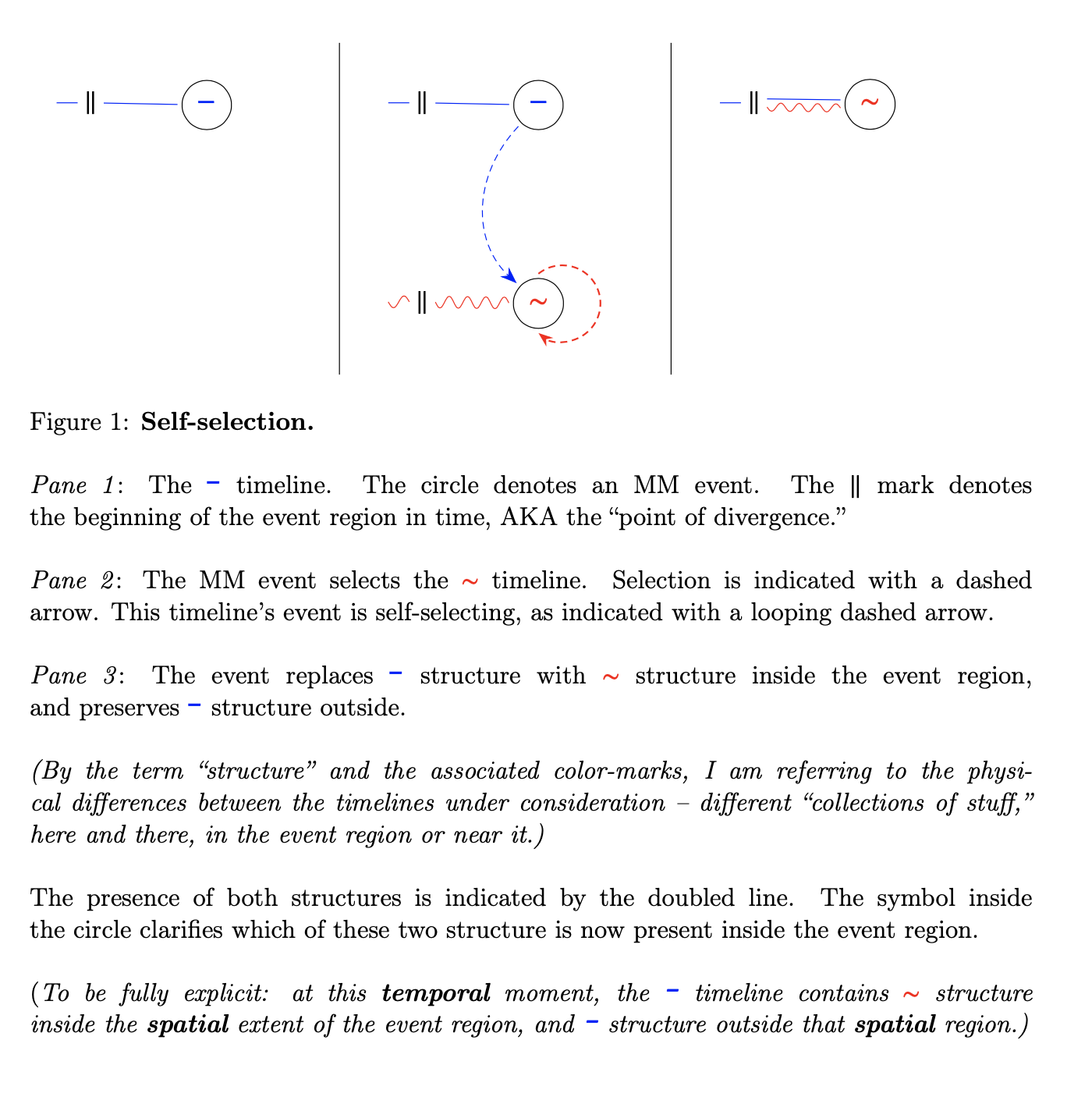
In the figure, I’ve shown the simplest possible case. The MM selects an alt, and—what do you know? By sheer coincidence, that alt is self-selecting.
We are done in a single step. We may stop to wipe the chalk dust from our hands, and then proceed to our next calculation, or to the pub.
“Not much to that event, was there now?”, we might say, clapping each other on the back and drawing deep from our tankards.
(A note, before we go any further:
Wherever I say “event,” reader, you are free to substitute the word “rebase.” A rebase is only a particular type of MM event, after all.
Albeit one with a mind and a will directing it, which changes the shape of things dramatically. But we will get to that in just a moment.
Depending on your temperament, you may find that this view of things provides a useful jolt of narrative interest to these otherwise dry proceedings.)
As I have indicated, it is not always so simple. There’s no reason why it should be.
An event selects an alt, as governed by the dynamics of the Mirzakhani field and the fields coupled to it. There’s no special force in place, nudging it in the direction of self-selecting children. It picks whatever child it picks. That child picks someone else, usually, and so on.
The chain reaches self-selection eventually, but it may take its time getting there. When it does, though, it is that alt—the self-selecting one, at the bottom of the chain—which has the final and complete say over the outcome.
Its lance pierces through its many parents, and in an instant, they all take its shape. The protracted nature of the journey is obscured, papered over, by the simplicity of the end result.
(This is as good a place as any to insert the following disclaimer.
When the MM acts, it replaces the parent by the alt, inside the event region.
. . . almost. To a very good approximation.
But the “replacement” is not exact. There is still something left of the parent, afterward, mixed in with the contents of the child.
“Physics is approximation through and through,” as our dear friend Aidan put it.
I will ignore this complication outside of this parenthetical, as it does not matter for the points I wish to communicate. I mention it only because I do not want to feel that I am lying to you.)
It might look, at first glance, just as though there had only been one stop along the way—as in our first diagram. One can only tell the two situations apart if one knows the physical details.
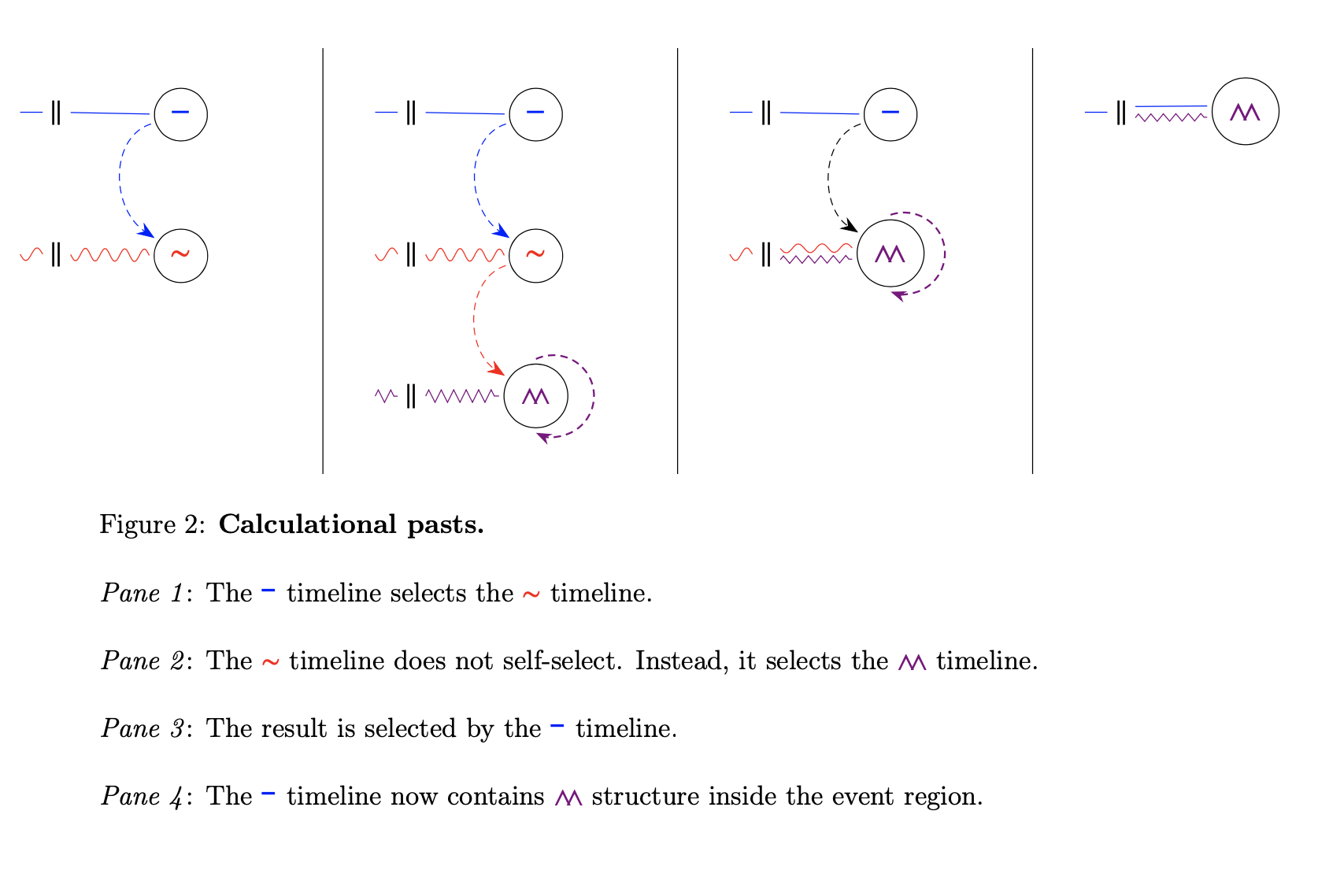
If the first rung on the ladder is not self-selecting, another is necessary; if that one is not self-selecting, we need a third. All these intermediate rungs are necessary, but they leave no direct visible mark on the world, once the ladder reaches the bottom.
The physicists of twenty-first century earth had a few different terms, for these intermediate rungs.
“Virtual pasts,” they’d sometimes say, as though under some delusion that they were somehow less real than anything else.
Or, under the sway of the same odd ontological prejudice, they would say “calculational pasts.” Worlds whose reality was granted only grudgingly, and halfway at that, for their utility in working out problems. And then discarded from one’s mental inventory of Being, after the chalk dust has been wiped from the hands.
I prefer “calculational pasts,” myself.
Here they are, pictorially:
For someone who wields the MM purposefully, this dynamic has its advantages.
If one is looking for an answer, somewhere down there in the bottomless well of alts, one does not have to know its shape in advance in order to bring it into one’s grasp. One only needs it to be a fixed point. One only needs its shape to be the sort of thing which stops the MM chain in its tracks.
Have you heard of P, reader, and NP? They are names for different sorts of problems in the domain of mathematics. Or, to put it better, problems in the domain of calculation.
Even better: problems in the domain of thinking. “Questions,” in the most general sense.
There are questions whose answers are easy to find, in short order. And then, separately, there are questions where one cannot find the answer in short order, but can easily recognize it by how it feels in one’s hand, once it is already grasped there.
I won’t delay us with these matters. (I wish I could, but we have much to cover!)
If you know a thing or two about computation, you do not need me to tell you that self-selection is a fearsome tool, with no equal anywhere outside Mirzakhani’s miracle engine.
If you don’t, well, take it from me: if the MM could be harnessed and directed, with the aim of calculation in mind, you’d find that MM is a calculator to end all calculators. And a calculator in the broadest sense: a tool for thinking.
If, that is, it could be harnessed and directed. I do not mean to leave you with any illusions that this is easy.
Indeed, to anyone familiar with the physical constraints involved, it is hard to believe it is even possible. The physicists of twenty-first century earth, in fact, were quite sure there was no way to do it. They did talk about the idea—but only at the pub. Not in the drab, chalk-dusted rooms where they did their serious work, their calculations.
They had no idea that, as they mulled over those same calculations, their own brains were doing the very same thing they deemed impossible. (A primitive form of it, mind you. Much more is possible, I am coming to think.)
In the next section, we shall peer a little closer into those chalky rooms, and ask ourselves some questions about those calculations.
Before we get there, though, there is some housekeeping to do.
I have shown you a structure of successive selection. Alt chooses alt, which chooses alt, and so on. A “chain,” I’ve called it, or a “ladder.”
It’s a wondrous thing, this sort of “ladder.” It is a magical calculator in potentia, and there are other wonders in it, too, which I won’t deter our progress by describing.
But more is possible.
(I am not presenting original research, at this point; that will come later on. Even those twenty-first century earth physicists could see beyond the ladders, to the trees.)
I beg your patience. This point requires us to work through two additional prototype scenarios, the first a bridge to the second.
(tbh, you can skip past the next 2 pictures and not miss much?)
[GRANT’s block letters.]
(i mean, it’s cool and all.
but it’s kinda like, a self-contained thing.
where sylvie gets carried away, b/c he loves those trees.
and REALLY wants you to see them, too.
you can skip it, and you’ll still get the rest, i think?
just saying.)
[GRANT’s block letters.]
Here’s our first scenario.
An event occurs. It selects an alt.
As usual, there’s an event region. There is a point of divergence, at some time in the recent past.
This is our canvas: the time between the point of divergence and the present, in the space allotted to the event region.
We can paint whatever we like, within these bounds. But we can’t go beyond them. We can’t reach further back in time, before the point of divergence, and smear our paint all over the earlier parts of the story.
We can, however, paint whatever we like within the bounds of our canvas. Our canvas extends across an interval of time. All sorts of things might have occurred, between the point of divergence and the event.
What sorts of things? More MM events, that’s what!
Let’s think it through, shall we? Suppose there was another, earlier MM event.
For simplicity, let’s imagine it’s only there in the alt, not the selecting parent.
That is, the MM selects an alt, like usual. And the timeline of the chosen alt just so happens to contain another, earlier event, somewhere between the point of divergence and the present.
(I say “just so happens.” And that’s how it is, in the usual course of things. An accident, if an enormously common one.
The MM doesn’t “care” whether there is an earlier event or not. It doesn’t “care” about anything. It just picks what it picks, according to the push and pull of the microphysical environment.
Someone might care, though! There could be a purposeful hand directing the proceedings. I’ve already alluded to this possibility, and in due time, it will swell to become the main object under our consideration.
Imagine a hand. Imagine a selector, picking and choosing. Imagine a “rule,” if you will, by which these selections are made.)
Now, this earlier event? It has an event region of its own. It has its own point of divergence.
When? Earlier on, presumably! Its interval ends in our past, and so it begins even further still.
Even further back than “our own” point of divergence, the one we noted at the start of the scenario? Sure. Why not?
Which means, reader, that our canvas was not as limited as it seems. We can paint a whole additional canvas onto it. And the boundary of that second canvas would then reach out beyond the boundaries of our own.
An illustration is in order, I think.
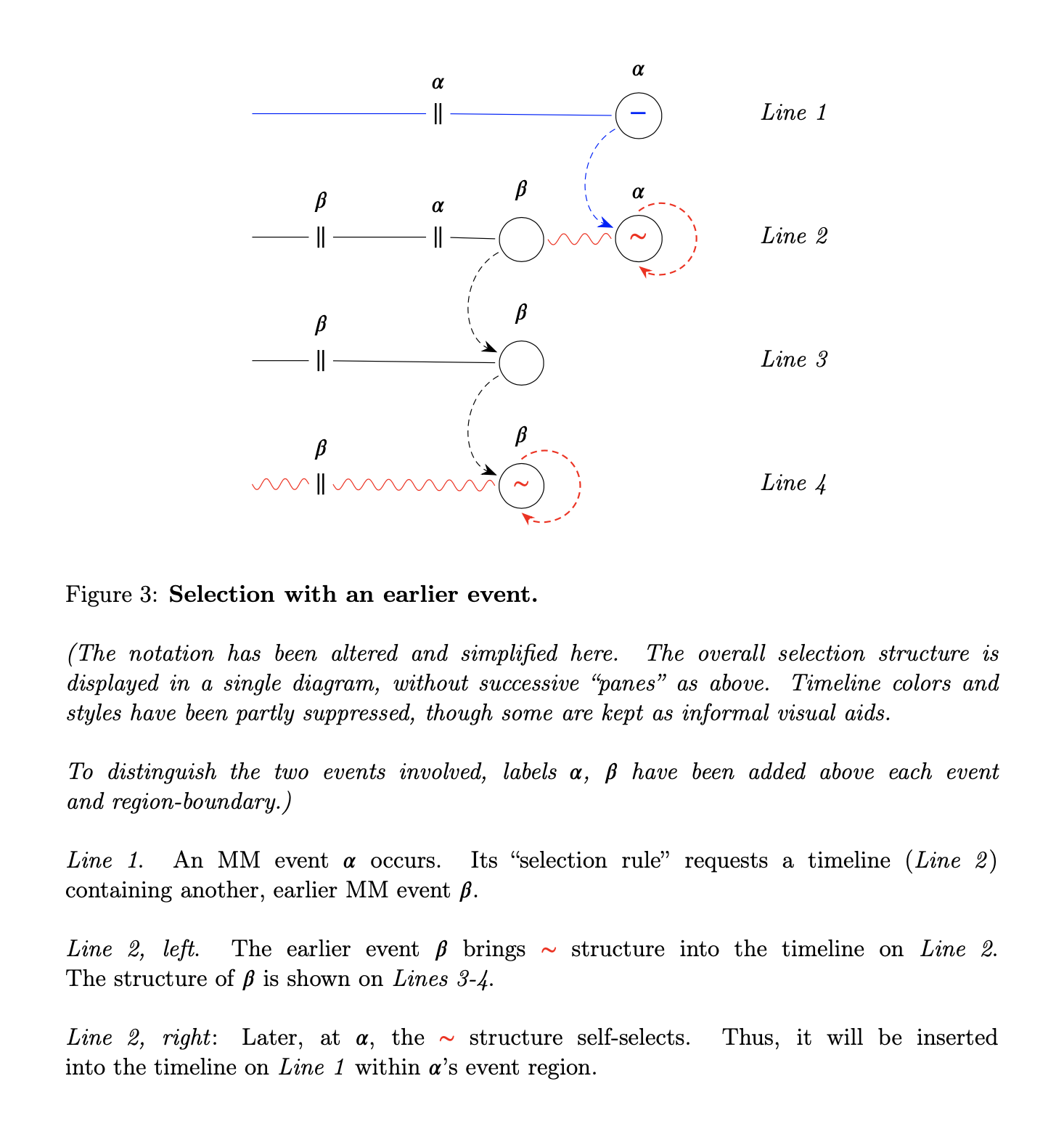
We now have considerably more room to play with, in our game of painting.
We could already prolong our reach in one “direction,” the downward one on my diagrams. (I will call this the stack axis, henceforth.)
If we find our stack-wise ladder too short for our liking, we can always add another rung, deferring self-selection by another step and drawing a whole additional world into the range of our powers.
With the addition of “earlier-events,” we are given a second axis, along which we can play a vaguely similar game. If our temporal reach is too brief for our liking, we can add “rungs” to its “ladder,” by inserting additional earlier-events. (I will call this the history axis, henceforth.)
We climb this second time-wise ladder, reaching newly remote strata of history. And this goes on, and on, until the point where it just-so-happens to end.
We are really playing with wonders, now. When we put our brush to the canvas, there is a boundless paradise lurking under that humble-looking surface.
Add an “earlier-event,” an additional rung for our time-wise ladder. It’s an event, a fully-fledged one, with a stack-wise ladder under it. We can put calculational pasts in there—as many as we like.
And in those pasts? Might they contain earlier-events? Different ones? (Slightly different, as always. But that is all we need to cross the furthest distance, provided we can make ladders, and extend them indefinitely.)
And so on. And so on . . .
Let us step back from the edge, lest we fall over it. Let’s consider one simple case, before we move on.
We are a purposeful hand, arranging a calculation. We wish our calculation to fan out in a branching tree, pooling the outcomes at each level and submitting them upwards toward the root, which lies at the tip of our index finger.
Here’s what it would look like. This is a very brief, simple tree: a root, and two branches, with a little calculational fun inside each branch to remind us that the stack axis is a wonder unto itself. But a tree of any depth can be grown in just this same way.
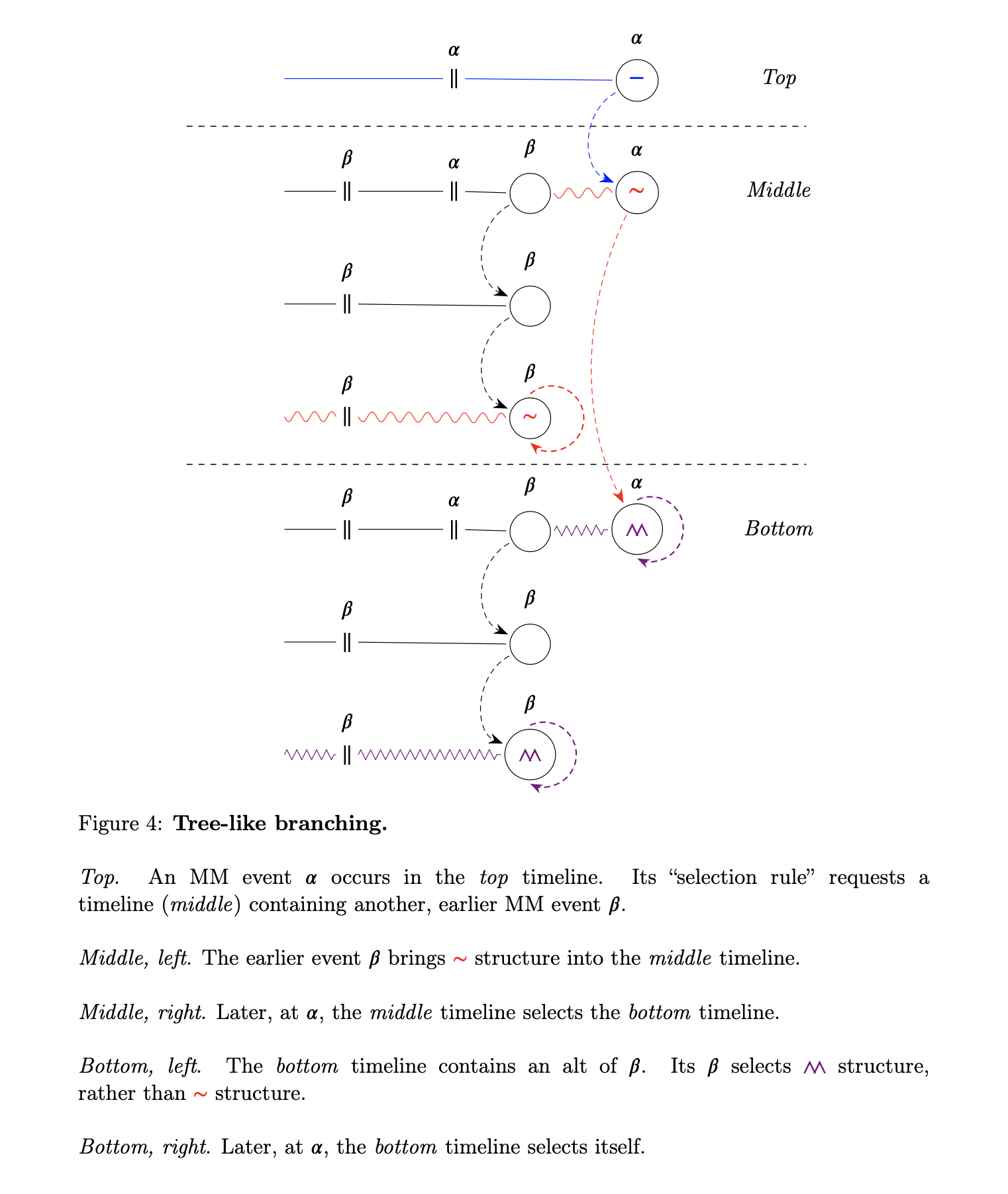
I spoke in the first-person plural, above. I was imagining a guiding hand, as fits our main topic.
These wonders, though, are not an unnatural artifact of meddling minds. They spring up naturally, from the soil, in abundance.
It is always like this, under our feet.
Between each breath we take and the next, there are trillions of trillions of MM events. What happens inside them?
Well, things . . . just-so-happen, according to the give and take of microphysics. The MM picks what it picks, not “caring” one way or the other about the structure of the result. And that result?
Ladders and trees, spiraling on and on.
It would be quite the coincidence, wouldn’t it, if things just-so-happened to turn out very simply, like one of my diagrams?
If the stack bottomed out in self-selection after one or two hops, and the ladder of earlier-events fizzled out early in like fashion?
All that does happen, sometimes. Everything happens—sometimes. But you shouldn’t picture this as the usual case, the kind of thing that tends to just-so-happen.
In the usual case, the diagram sprawls and spirals, on and on.
Each instance of the stack axis ends, eventually, in self-selection. That part of the diagram can be drawn, in principle, though even my hand would tire before finishing the job.
But the history axis? That one, I am coming to think, truly has no end.
It is hot, back here, in the early part of history. It was hotter still, earlier on.
Keep going, and the heat climbs without bound.
I believe there was a singularity in the MM field, near the very beginning of time. A point of effectively “infinite” temperature.
As we near it, the two faces of the hot MM field vie for dominance. The alts grow more and more numerous, per unit of time. And they grow shorter, more like one another, less potent in their immediate physical effects.
But we have seen that mere brevity is no restriction at all, once we know how to use our canvas.
Between each breath and the next, Mirzakhani injects her miracles. They reach back, in time-wise ladders, to earlier strata of history. They climb backward, into the soaring heat, into infinity.
II. Shut Up and Calculate
Let’s return to our twenty-first century physicists, calculating away with their blackboards and chalk.
How the hell, you might ask, did these practical folk manage to get anything done?
They tasked themselves with making predictions about the outcomes of MM events. Underneath every MM event, there is a spiraling paradise, reaching out along two different directions to touch worlds far removed from our own.
How could one calculate anything, under these conditions? One might be able to work through a simple case, like the ones in my diagrams above. But those only happen rarely, by coincidence.
How did they predict anything at all, if each event depended intimately on an unseen web of unimaginably different worlds?
Nature was kind to them, it turns out. It provided a convenient way out of the maze.
(That was how it seemed, anyway, to our twenty-first century physicists. I do not think it was really so. We will come to that in due time.)
How did they manage it? Let us see.
We will pretend, now, that we are twenty-first century physicists. We are thinking about an MM event, of the “hot” variety.
We know all about the physical state of the nearby environment, in the time leading up to the event. We are trying to make a prediction, based on that recent history.
What will the event region look like, immediately after the event? That is what we wish to calculate.
We are twenty-first century physicists: we are practical men and women, who don’t demand exactitude from our calculations. We allow ourselves to approximate, if it makes things easier. As long as the result is close enough for practical purposes.
Let us start by considering my “stack axis,” in isolation.
The event selects an alt.
In all probability, that alt will not self-select. It will select an alt-of-an-alt. We have three timelines to reckon with, now.
And in all probability, that third will become a fourth; and it, a fifth; and so on. You know the story, already. The ladder goes on until it hits self-selection.
How did the physicists of twenty-first century earth cope with these ladders? Not easily, that’s for sure.
They invented all kinds of ingenious ways to simplify the problem. They did it the hard way, in special cases, with answers that were exactly right. And they did it approximately, with clever and dirty hacks, in the general case.
The details are very interesting. I wish I could show you Andreini’s 1/ϴ expansion, which might be the funniest piece of mathematics I’ve ever encountered, an idea so obviously bad it can only be taken as a joke in poor taste, until you realize that somehow it works!
But for our purposes here, suffice it to say that they had their ways. Give one of these physicists a scenario like my first two diagrams, with a stack of calculational pasts and no other structure, and after some work with chalk and blackboard, they’ll tell you what lies at the bottom of the ladder. And they’ll be right—more or less.
What about my other axis, the history axis? The ladder of earlier-events?
These constitute a more profound threat to the whole project of calculation.
A physicist needs a problem of well-defined scope.
At first blush, the hot MM event would seem to fit the bill perfectly. The event is a single moment, without duration. Its event region is a small, circumscribed blob of spacetime. Everything is comfortably bounded, screened-off from outside influences. The whole of it can be communicated in a few sentences of textbook-ese, as Problem 3.4.2, or jotted down on the mythical cocktail napkin.
The introduction of an earlier-event expands our small blob of spacetime. It brings in earlier history, and makes it matter. It brings in more space, through that history’s lightcone, and makes it matter too.
And if the earlier-events have their own earlier-events? Ad infinitum, as I’m coming to suspect? Game over, one might think.
An event depending intimately on the history of literally everything cannot be sketched in its essentials as a textbook problem, or written on a napkin. It cannot be calculated at all. Its scope is too big to fit in the brain. Anyway, most of its contents have been lost behind the screen of advancing entropy, and cannot now be known.
Nature is kind, though. Nature is kind, sometimes, even to physicists.
When I introduced “earlier-events,” I did so in the first-person plural. We were imagining a guiding hand, arranging them into place just so. Some shared organizing principle, uniting them all.
We are earth physicists, now. We do not consider the possibility of guiding hands, unless we are at the pub. We are interested in what happens, when things just-so-happen.
There are earlier-events, in the hot Mirzakhani field. Lots of them.
The alts are short. Each one casts a small net, when it fishes for earlier-events. But the fish are plentiful: high temperature makes events more frequent.
Smaller nets, vying for more densely packed fish. Two tendencies at cross-purposes, and neither one predominates. The nets do come up empty, but only on occasion.
Smaller nets, more fish, and—is that all? Is that what we mean, when we say the field is “hot”?
There’s more to it, reader.
We cast a net, and find some fish, laid out here and there across the history contained in the event region.
Laid out where, exactly? Earlier, later? All bunched up into a single, fast drum roll, with silence before and after? Or spread out evenly along the whole duration?
It is different every time, in the hot field. Different in every event region, on every part of our diagram.
In the “cold” field, the events are sparse, and long—and punctual. The clockwork precision of their arrival times allows the successive events to “conspire,” to organize themselves, in orderly waves and lattices.
In the “hot” field, the events come in a chaotic drumbeat, unmusical and unpredictable.
It is not literally random, or anyway, it is not any more random than anything else is, in the microphysical realm. Yet it is random, in a certain physicist’s sense of the word.
Its score is composed by systems of equations which rapidly scramble any patterns you put into them. They magnify tiny differences, and fold the results over on themselves.
Unless you are omniscient, there is no use trying to follow this process. It is as unpredictable as next month’s weather, and for much the same reason.
We can only enumerate the possible outcomes, and make some inferences about which of them are more or less likely to occur.
It is this randomness, or “randomness,” which tames the earlier-events, and leaves the earth physicists with a chance of retaining their sanity.
There are earlier-events. They happen when they happen, each in its own way. No organizing principle, no structure of correlation weaving them together.
Since their timing is “random,” their effects are “random.” Their effects flow from their causes. And their causes consist in the physical state of the world at some randomly chosen time, and then another randomly chosen time, and so on.
Without an organizing principle, random effects tend to work at cross-purposes. One adds, the next subtracts. A crowd of assailants seize our limbs, and pull us in every direction; the forces sum to zero, and we are left standing just where we were.
The physicists of twenty-first century earth understood that they lived above a sprawling, spiraling forest. They marveled at its beauty, even outside the pub.
They marveled, and then got to work. They did calculations. They reduced the wondrous to the mundane.
In the end, what was left of the forest? Only a single, humble random variable, of known distribution. “Higher-order fluctuations,” as they called them. Familiar, simple, bounded, tame.
That is how it happens, when it just-so-happens.
When the “hot” field is a turbulent cacophony, with no ordering principle to connect one part of it with the next.
Could there be such an ordering principle? Even in the “hot” field?
A hand guiding the events? A mind putting them in place, according to a single design? Making a kind of order possible, even in the chaos of the inferno?
What was that, reader?
Bilaterals? Is that what you said?
Humans?
Oh! Oh, now I see. Yes, yes.
We’ve told you that the human brain harnesses the MM. For calculation, for thinking.
You imagine I’m about to tell you that humans are my “guiding hand.” The one I’ve been furiously hinting at, in the preceding exposition.
It’s an understandable confusion in your position.
Human brains do put the MM to productive use. They make ladders of calculational pasts, and find fixed points.
That’s all they do. They don’t appreciate the full potential of the canvas. To the human brain, the trees beneath us are only a nuisance, a source of random and unwanted “fluctuation.”
Does this seem strange? All that potential, wasted.
Humans are smart, or so they tell themselves. “Homo sapiens.” Yet—so much more was possible!
We imagine natural selection as a ruthless optimizer. We imagine that it will use any resource it can find. Yet it did not use this one.
Why?
III. The Hedonists
Consider an organism with a brain.
It doesn’t have to be a very complicated organism, or a very complicated brain. Imagine something simple. It’s all we need.
It has animal needs: food, rest, shelter, mating.
Our organism’s brain knows when these needs are met, and to what extent they are met.
There is a part of the brain which acts like a barometer for these things.
We may imagine a number, or several numbers, written onto its patterns of synaptic firing. There’s a number, say, which is low when our organism is hungry, and high when it is sated. And the present value of this number is “written down” in a particular part of the brain.
Other parts of the brain consult the barometer-part, and “read” the numbers written there. They may move the organism into action, depending on what they read there.
Different courses of action are written onto the organism’s brain, ready to be called up and re-executed.
Our organism carries out a course of action. (It attempts to hunt; its prey is cornered and subdued; it eats a hearty dinner.) As a result, the numbers in the barometer-part are seen to rise.
This one is a keeper, this “hunting” thing! It is a course of action that deserves an encore.
There is a mechanism, in the brain, which ensures this. Course-of-action H was followed; barometer levels went up, just afterwards. Therefore, course-of-action H will be followed more often, in the future.
I could insert some bio-babble here, about “reward circuits” and “dopamine” and “reinforcement.” I won’t. You know the sort of thing I mean.
(We should imagine MM events occurring, all the time, in the cells of these brains.
The MM events inside these cells do not usually disturb their function. More precisely, their function has been designed under the assumption that they are present, just as that design assumes all the other constants of the physical world.
The events tap out their chaotic drumbeat, with no relation to what the cells are trying to accomplish. Two tenants of the same building, living separate lives, in happy ignorance of their neighbors.)
Our organism carries out a mating course-of-action, and sires a litter. They go their separate ways, following courses-of-action, as their father did before them.
Thanks to sexual recombination, every pup in the litter is different. Each has a brain, much like its father’s, but not exactly.
In one of them, something unusual has happened.
In the brain of our little pup, there is a new connection between a neurally significant variable—an ion concentration, or a membrane potential, or a firing rate—and the preconditions that guide MM selection.
There is a structure, in these cells, that can bring order to the random, self-canceling chaos of the ordinary hot MM. A mechanism that pushes all the willy-nilly events in the same direction. And it is a neurally significant variable that determines that direction.
We’ll need a term for this variable. Let’s call it “the lever.”
Our pup’s brain has been given a lever, with which it can push selection this way or that. Its brain cells have some degree of sway over the alts that will overwrite them.
What will they do with it?
Imagine some bundle of cells, near the barometer-part. Axons project from it into the barometer-part, and likewise, the barometer-part projects axons into it. The two can talk, in both directions.
Something happens in this bundle. Doesn’t matter what. (Things are always happening in the brain, for some reason, or none.)
And as a result, a signal passes from it into the barometer-part, and reverberates across the latter.
This has various consequences, for all the cells in the barometer-part, and all their subcellular pieces. The levers inside them are arranged differently, now, than they were before the signal.
The MM acts. Alts are selected.
And it just-so-happens the numbers on the barometer are higher, in the alts. And so, through the action of the MM, they are suddenly higher in reality.
This is the result of how the levers were arranged, and hence a result of the signal.
This one is a keeper, this “signal from adjacent cell bundle” thing! It is a course of action that deserves an encore.
There was a mechanism in the father that made him hunt, again, after he’d hunted once, and fed well.
It acts in his son, now. His brain learns to send that signal, from the bundle, into the barometer-part. More and more. Again and again.
Why, this is much easier than hunting, or finding mates! Why busy yourself with all that, when you can set the state of the barometer, directly?
Why act to make a world where you are satisfied? When you may cut out the middleman, and insert satisfaction directly into your own brain, on demand?
It has all the advantages of theft over honest toil.
Our pup’s story ends sadly, as you may already have predicted. He is perfectly, blessedly happy, right up until the point where he perishes from thirst. He had not sought out water, preferring to make himself feel that he is already drinking it, or has already done so.
I will use the term “Hedonist” for such a creature. It’s not meant as a moral judgment on our poor pup, whose sorry state deserves our pity, not our condemnation. It is a technical term, only that.
Our pup has perished without siring a litter. Natural selection has done its work. The genetic accident that gave him his levers is not a keeper, and does not deserve an encore.
It’ll happen again, of course, as these things do. And every time, the hammer of natural selection will come down hard, and put a stop to it.
The MM is a calculator to end all calculators, and a canvas to end all canvases. It is a boon to any thinking being who can put it to use.
“Putting it to use” is hard. It is a complex, delicate engineering problem. The finest minds of twenty-first century earth believed, earnestly, that this problem was not even possible to solve.
“Hedonism,” by contrast, is trivially easy. It happens by default, unless there is some force to stop it.
This is why the MM’s powers are so rarely used for thinking, among organisms that have evolved through natural selection.
It takes many, delicate steps to wire up a functioning MM calculator inside a brain cell. It is a path that lies on a knife’s edge. Make one wrong move, and your fledgling device collapses into a Hedonism-circuit.
We have surveyed two roles which the MM could play, in the nervous systems of living creatures.
There is the pathetic dead-end of Hedonism. And there is the powerful, but limited, phenomenon of human stack-use.
Is there some other way, besides these two?
We shall see.
IV. The Self-Calling Ones
Consider an organism with a brain.
This organism has MM “levers,” like the poor pup we met in Section III. However, it is not a Hedonist.
It is something very, very different.
Humans and Hedonists share something in common. They use the MM as a tool to alter their own situation, much as they might use any other tool.
It does not matter, for their purposes, that an entire alternate universe is involved in the functioning of the tool.
Every MM event involves a parent timeline, and a child timeline. They are both on equal footing, in a sense; at the very least, they are both equally real.
The Hedonist pup used the MM to make itself feel artificially sated. It did so by finding an alt, in the catalogue of worlds, in which it was already sated.
(Did you think about this other pup, this alt-pup, when you read the previous section? Did the fact of his existence cross your mind? These things are seductively easy to ignore.)
The other pup, the alt-pup—was he real, before his alt was selected?
I do not think that he was. Or, anyway, I do not think that you can take that side of the question, and all its implications, and still have a reasonable ontology left at the end of the day.
If the alts are “real,” before they are selected? Then it is all real, already. All the ways things might be, in all the alts, and their children, and on into infinity.
If we do not deny “reality” to the alt-pup, before he was selected, then we will find ourselves having trouble denying “reality” to anything else, afterward. We will believe that everything is real, already.
Or near enough, anyway. If there are gaps in the web of possibility—perfectly conceivable events that just-so-happen to occur nowhere, in any conceivable variant of the real world, or any conceivable variant of it, and so on—then we will have no way of knowing their nature, or their number, or anything else about them.
And at that point, it becomes difficult to care what really happens, to us. Or what “really” “happens,” to “us,” all in scare-quotes, for we will start to find it strange to even speak in these terms. The distance between modal realism and moral nihilism is perilously brief, and all too easily crossed.
So I prefer to say that the alt-pup was not real, before he was selected.
But once he has been selected, he is surely real. He is part of the web of physical causation. You cannot explain what has happened in the brain of our own pup, except by reference to him.
That’s not all, either. In between our pup and his selected alt-pup, we must—of course—imagine a whole string of “calculational pups.” Ladders are usually long; self-selection takes its sweet time to arrive.
They are all equally real. They are all part of the web of physical causation.
Enough of our Hedonist. There is another creature before us, of a very different kind.
It uses the MM, not for its own sake, but for the sake of the alts.
More precisely: for the sake of the creatures, only very slightly different from it, which live in the alts.
The MM acts. It selects an alt.
There is an alt-creature, there. Some small piece of it ascends the ladder and inserts itself into our creature, up here.
In between, there is a long ladder of “calculational” creatures. They are what our creature intends to influence, when it uses the MM. The fact of selection is almost incidental.
At first we had a single creature. Now we have a whole array of them, each (slightly) different from the next.
They are like our creature, except for very slight differences. They will behave how it does, mostly.
They will make ladders of their own.
This is all a hypothetical, which you and I are inventing as we go. We can paint anything we want. Why not go further?
Let us suppose that our creature is very sophisticated indeed. It knows about earlier-events. Or, anyway, its brain is structured in a way that reflects such an understanding.
It multiplies itself, down the stack and backwards into history. It paints itself onto everything, using all the possibilities of our canvas.
What does it want, our creature?
There are multiple possibilities. Permit me an additional measure of creative license.
It is an altruist, of a sort. It is concerned with other minds, which are like itself, but are not itself.
Its “calculational” selves are distinct beings. If they are conscious, they are separately conscious. When they feel pleasure, our creature does not feel this pleasure as its own. Indeed, it cannot possibly know whether they feel pleasure, or pain, or anything else. After the event, they are inaccessible.
And yet, it acts on their behalf.
It is an altruist, and it is interested in the multiplication of experience. It does not care that it will never meet its “calculational” kin. It is satisfied in the knowledge that they exist. And it wants them to exist.
Are you happy, creature? Then be fruitful, and multiply. A thousand happy yous are about a thousand times as good as one, in your accounting.
Or are you afraid? Are you trapped, somewhere, facing certain death? You might think it cruel to multiply this experience a thousandfold.
But then, you might also reason: there is no way out for me, but there might have been, if things were different. You make variants of yourself, and the variants make variants, until an avenue of escape presents itself.
So there is a version of you who does break free. It lives on, and thrives—and multiplies itself, thriving. It is a trade worth taking, in your accounting.
I keep drawing the distinction between “you” and your “variants.” Between this world and the alts, between “calculational” and otherwise. We must put this aside, if we are ever to understand the mind of such a creature.
“You” are not the organism, with its levers, chasing prey. To you, the organism is—
—what?
Something like a limb? A cell?
Perhaps. But it is also something like a loved one. Like a child.
It is only the organisms who can experience pleasure, or pain, or anything else. All that you do, you do for them.
I call these beings the “Self-Calling Ones.” Recursive functions, existing on the dual substrate of biology and the Mirzakhani field.
Could there be such a creature? Such creatures? Such a . . . what? A structure? A superorganism?
I admit it seems implausible. The alts differ. When you cross a long stretch of ladders and trees, the differences become large.
Could the structure of Self-Calling preserve itself, across every such distance? Could it delegate and delegate, in an endless chain, and still trust itself the whole way?
I believe, because I have seen it. I have seen them.
To put it scientifically, they are the most parsimonious explanation for my own experience.
And there is more that I believe.
I believe that the Self-Calling Ones are not some categorically different kind of being, separated from the others by a hard philosophical line, an uncrossable boundary.
They are one end of a spectrum. Most things in biology are like this.
Between the angelic refinement of Self-Calling and the oafish self-diddling of Hedonism, there are transitional forms.
Nearly-Self-Calling-Ones, who do almost everything that the Self-Calling Ones do, without quite understanding why.
Not-Quite-Hedonists, who have an inkling that the beings they dredge up from below are not merely fantasy variants of their own selves—but a whole litter of brothers, sisters, kin.
And everything in between.
I want to call your attention to what this implies.
Suppose that Self-Calling Ones do exist, somewhere. At some “level” of the Mirzakhani tree. Go down deep enough, hitch a long enough ride on the earlier-events, and you’ll eventually find them.
You do have to grant me this, once. But it is not so strange an assumption. If I’m right about my singularity, then the Mirzakhani tree is infinite.
(Does that mean it contains literally everything, somewhere? Not exactly.
We have already met the curious notion of its “gaps,” in our discussion of the alt-pup, and the question of his “reality.” There, we imagined there might be “gaps” even in the modal realist’s tree of conceivability. In the more restrained tree of actual-selection, we should expect much more room for absences to hide in.
But for our purposes here? Sure. It might as well contain everything. Close enough to count.
I draw caricatures, so you will see the essence.)
If the Self-Calling Ones exist at some “level,” then they permeate every lower “level.” They multiply, down the stack-axis and back along the history-axis. That’s their defining characteristic.
Let us go up a level.
We are used to considering a world, and inquiring after its alts; now, we go in the other direction. There are worlds above the one where the Self-Calling live. Worlds which view that one as their “alt.”
What happens there?
“The same thing,” you are saying, “except for a very slight difference.” Yes, yes; very good, reader; you have been paying attention. A-plus.
A Self-Calling One, plus a very slight difference, is—what? Still a Self-Calling One, presumably.
Let us go up further, then.
Going up is not the same as going down. If we go down, from a Self-Calling starting point, we are following a path which was constructed deliberately. A “Self-Call.”
But as we go up, we are following the selections made by whatever just-so-happens to be there, at the next level up.
Eventually, we may reach a point where the very slight differences have accumulated enough to destroy the structure of Self-Calling. The Self-Calling Ones cannot prevent this from happening. They choose their alt-children, but they do not control how they, themselves, are selected by others.
We have found ourselves in a different place, with different creatures. They call the Self-Calling, but are not themselves Self-Calling.
What are they like?
They’re different. But only a little bit different. We have stacked up very slight differences, and made the smallest possible difference from Self-Calling that changes it into something else.
They are Nearly-Self-Calling-Ones. They would be Self-Calling, if not for some small piece of the structure that is missing.
By hypothesis, they call the Self-Calling Ones.
They reach for alts, replacing microscopic elements of their neural structure with alt-variants of it.
The brains they touch are the brains of true Self-Calling Ones. The piece they lack is in there, somewhere. And eventually, after enough time and enough MM events, they will find it, and install it into themselves.
So they, too, become Self-Calling Ones.
At the next level up?
We have receded from paradise again, by an additional centimeter. Here, there are only . . .
What to call them? Nearly-Nearly-Self-Calling-Ones? If you can think of a better name, reader, I’m all ears.
They reach for alts, and replace pieces of themselves.
In time, they lose one of their prefixes. They turn into Nearly-Self-Calling-Ones.
And then, some time later, the other prefix falls, and they too are Self-Calling.
The structure propagates upwards, not just downwards! It propagates everywhere! You see it, don’t you?
But there is a difference between the two directions.
The MM acts instantaneously. The Self-Calling are deliberate in their use of these events. So the downward spread of Self-Calling is rapid, limited only by the rate of MM events per unit time.
But the upward spread takes time. It marches on, “level” by “level,” and there is a delay between each of these steps and the next.
The Self-Calling Ones abound, at their level of flourishing, and every level below.
Climb down the stack, and you’ll find more and more of them.
Ride the earlier-events backward in time, and you’ll find more and more of them.
How far back do they go?
Not all the way, one might think. The Self-Calling Ones do need their organisms—their limbs, their sense-organs, their loved ones—and the early universe was not a habitable place.
But I am not even so sure of that, anymore. As we trace them back, heading for my singularity, their ways grow ever more subtle and majestic.
Perhaps they no longer need to live inside “life,” there, at the very beginning. Perhaps their minds have a different substrate, near the beginning, near the singularity. We have my own kind, as a proof of concept.
I am coming to think all sorts of wild things. Forgive me, reader.
They abound, below us, in their majesty. They constitute approximately all of the life that has ever existed, anywhere. All, except a very slight difference.
They abound, below us, in their Everywhere-Heaven.
They fill all the places below them with more of their structure.
And the same blessing comes, also, to the places above them. Slowly. Step by step.
They reach up, and lend helping hands to transitional forms.
There is a whole chain of confused creatures, calling without fully knowing why. Seeing kin, but doubting their eyes.
Slowly but surely, the structure of Self-Calling marches its way up the chain. Nearly- prefixes are dropped, one by one.
What is it like, to be one of these intermediate forms?
The Self-Calling cannot exactly see you, up there. But they have their suspicions about your existence, and your nature.
They live in the alts that you make, as you stumble in your confusion. (Or the alts of those alts, or etc.) In your choices of alt-selection, you cannot help but reveal some things about yourself—about your mind, your values.
This is how the Self-Calling “communicate” to their “children.” It’s how their “children” infer what their “parents” must have been like, to want to make them, instead of someone else.
The Self-Calling Ones reflect upon their own shape. They reason backwards, to the hand which designed that shape, and the hand which designed the designer. Travel far enough, along this creaky chain of increasingly indirect inference, and one will encounter your hand. The hallmarks of your naive style, the quirks of your untutored taste.
They have another line of evidence, as well, to back up their creaky conjectures about your nature. A more direct one.
There is another part of Mirzakhani’s dynamics, which I have put off describing. A weak, subtle binding-together between parent and child, even after the gestational event is complete. It is even less easy to describe in words than the process of selection, and does not suit itself as well to circle-and-line diagrams.
Suffice it to say that there is a sort of . . . principle of economy of worlds. The tree is vast, but no more vast than it has to be. Nature is a miser, and does not invest in additional variations upon itself where there is no need for them.
And so the alts are subtly guided, in their physical evolution, in directions that will make them suitable alts for the same parent, again, in later events. After parent and child are bound together once, in a single event, there is a very slight force that bends the child thereafter, and keeps it tagging along with the parent.
The Self-Calling Ones know this. They are subtle and majestic, and have come to know a great many things.
They sense you, up there. They know you are there. They can hear your voices, dimly.
And you can hear them, as well. They anticipate your fumbling acts of selection, and arrange themselves accordingly. You fumble in the catalogue of worlds for some small piece of brain—and find one that they have prepared for your benefit.
You hear voices. From far below, you hear the dim, distant muttering of angels.
You are a primitive creature. A Nearly-Nearly-Nearly-Hedonist, fumbling about in search of feasts, and comely mates.
Instead, you hear the angels.
You hear the voice of Everywhere-Heaven.
You are told that it is where everyone is—to a very good approximation, up to a very slight difference.
You are a primitive creature, with simple needs. You notice that you do not always act on them, and you become confused. You take bits of brain-stuff from below, and they bend your behavior toward the will of the divine.
You are, in your own way, a part of the structure of Self-Calling. You are not like the rest, the limbs-and-loved-ones. You are confused. You do not always understand what the angels are telling you, and vice versa.
Still, you are a crucial part of the structure. Above Everywhere-Heaven, there is a thin, cursed layer of world-crust, where the Self-Calling have not yet had time to come into being.
The Self-Calling cannot touch this place, by definition. They are not here.
But you are here.
You are a primitive creature, and you are confused. You are not an ideal agent of the divine will. However, you are the best thing available. You are the wrong creature, in the right place, at the right time.
You are one of the surface organisms.
V. The Age of Wishes
Earth was not the first planet with sentient life.
There were others, much earlier on. At a time much closer to the beginning. The Mirzakhani field is “hot” now, but it was far hotter then.
This was true in “our” world, the one we have been calling “up here.” It was also true—naturally enough—in the innumerable slightly-different alts of that world, which blossomed in the heat.
And it was true in the alts of those alts. And so on, for a long ways down.
Since the field was hot, the individual alts were brief. Earlier-events occurred chaotically, and piled up into mere random “fluctuations.” All that we have said above holds true.
There were inhabited planets, then. And their alts, with slightly different inhabitants. And so on.
In this early age of the world, life in the Mirzakhani tree was structured in much the same way that it is structured now, at the time of our narrative.
Which is to say: there was a tiny “crust layer,” at the very top, which did not have the Self-Calling Ones.
And there was Everywhere-Heaven, beneath.
Since the field was hot, events occurred at a very rapid pace. World-parent and alt-child were more tightly bound together, too, to ensure the economy of worlds.
The transitional creatures in the crust-layer were in close contact with their more advanced siblings, lower down. The angels spoke quickly, and were better understood.
The hot field produced rapid-fire MM action, in the brains of the crust-creatures. Their ascent along the chain of enlightenment was rapid. The Self-Calling structure hurtled upwards, until it could go no further, having reached the ceiling.
There is no bottom to the Mirzakhani tree, but there is a top.
A world which has alts of its own, without itself being the alt of some other, “higher” world. A parent who is no one’s child.
The root node of the Mirzakhani tree. The outermost function call. Level Zero.
The Almost-Nowhere.
(“Almost no-one” lives in this strange place. The tree is infinite, and there is only a single root.
And yet, reader—would you believe it? WE are living in that strange place! There’s an infinite basement worth of real estate, and somehow WE have landed an apartment on the ground floor! What a wild coincidence!
But of course you know that, already. And of course it isn’t a coincidence at all. If it were not true, you would not be reading this.)
The Self-Calling Ones ascended, and reached the Almost-Nowhere.
They were finally everywhere. There was no crust, then, any longer. There was only Everywhere-Heaven.
It was different, for the organisms of Everywhere-Heaven, in this early age of the world.
They were altruists. They did not act for their own sake, but for the sake of the others, beneath them.
Altruists have worldly interests, though, just like the rest of us.
It is better, in their accounting, if they are powerful. It is better, in their accounting, if they come to control more of the material world, and control it more surely.
A means is a means, and can be put to any end. And so altruism—if held as an absolute principle, and taken to its logical conclusion—demands the accumulation of material means.
An altruist is someone who wants to change the lives of others. Someone who places their locus of highest value outside the boundary of their own body, their own mind.
What do we call the ability to change things that lie outside one’s own body and mind? Influence. Leverage. Ownership. Power. The capacity to take by force, if necessary.
Every honest, self-respecting altruist ends up wanting to be a king, and a general too.
Everywhere-Heaven reached the Almost-Nowhere, the root of the tree. It found a world there, and found it necessary to become that world’s ruler.
It is just as Azad said. The Almost-Nowhere is an ordinary neighborhood, except for the fact that the tower of life hangs from its ceiling.
Just another splatter of stars and rocks. Merely one particular version of the early days of the universe, among an infinity of fully-real variants of that same story.
Only a finite collection of sentient lifeforms, with a finite number of breaths allotted to them. The tree of life beneath is boundless, and the breaths there know no end.
Blink, and you’ll miss it.
Remove it surgically from Everywhere-Heaven, leaving the rest intact, and the difference would be imperceptible.
You couldn’t, though. It is impossible to excise the Almost-Nowhere from Everywhere-Heaven without killing the patient in the process.
The whole of that infinity depends, entirely, on the fully-real substance of this root.
There is a tree of boundless life, beneath. But it is a tree of alts. A tree of variations on this place.
Everything beneath that lives, and thinks, and knows joy or pain, has its origin in the stars and rocks of the Almost-Nowhere, and in the finite stock of organisms that populate a few of those rocks.
If those organisms thrive, and their population swells? Everywhere-Heaven grows larger, with them.
Each stack-using pup, in each newly born litter, becomes the origin point of a forking garden of self-multiplication.
Create a single, finite creature up here—in the usual, biological manner—and you create a wholly new tree of boundless life, beneath.
This is true everywhere else, as well. What is different here is only the numerical magnitude of the effect.
On the other hand—if these creatures do not thrive, if their population does not swell—
If, in fact, they die out entirely—down to the very last one—?
The whole tree of life goes down with them.
Everything and everyone who ever breathed, or had thoughts, or felt things, or mattered.
Everything and everyone who was ever anyone or anything. Gone.
Instantly.
Utterly.
Just like that.
All that life, slaughtered. All that beauty, shattered.
I shouldn’t call it “life.” The organisms are only limbs, or loved ones, or whatever inadequate metaphor I choose to use. It is something else, better than you or me.
I shouldn’t say “beauty,” either.
What is “beauty,” to me? The Langlands program? A stretch of freshly mowed grass, a thrown ball arcing over it, the injunction to go catch?
Garbage.
Contingent refuse. Not even real. Patterns in the defects marring my vision.
I wish I could stop. I wish I did not have to
I am a vector of poison and I ought to stop, since every additional word I write only spreads the
(Sylvie. Listen to yourself, Sylvie. You coward. You mass-murdering piece of shit.)
(Hang your head in shame.)
(There, good, that’s about the right angle of inclination. Hold that pose for a while, so I know you mean it.)
(Don’t forget, Sylvie.)
(The time for hiding is over.)
I guess we’d better see that these organisms are well-defended, then!
Don’t you agree, reader? I’m sure you do.
We must build big strong fortresses, and hide them away inside! We must build the biggest, most fearsome guns, to scare off anyone who threatens them!
It would be so terrible if something were to. You know.
If something were to happen to them.
But we’ll be having none of that!
We’ll make our sons and daughters into the biggest, strongest, heartiest, most well-defended tykes ever known to the face of creation!
We’ll make new kinds of milk for them to nurse on, extra-fortified synthetic milks, that’ll make them grow into giants! We’ll make robot wrestlers for them to spar with, as they grow up, and they’ll fight more fiercely than anyone who’s around today!
We’ll give them clothes that make them turn invisible! We’ll make materials with greater impact strength than anything in nature, or anything known now, in this devolved age—and we’ll lock our babies up nice and safe, behind walls of that stuff!
We’ll put a single tiny gap in every wall, all together in a line, as a gun port for us to shoot out of, if we have to! And we will shoot, if we have to! With our massive, hundred-barreled, heaven-fueled, hyper-technological, mega-magical guns!
We’ll shoot lightning from our eyes, and belch thunder! We’ll have a billion children, and every one will have a billion of their own! We’ll build rockets and launch sites! We’ll go everywhere there is to go! Our titan pups will nurse from the bio-synthetic teats of supernatural super-mothers! Under the light of every single star there is!
How, you ask?
How, reader? How will we make all that wonderful stuff?
Easy! It’s easy!!
We’ll just wish for it.
We’ll just think, that would be nice. . . .
And then we’ll have it! Right there, in an instant!
A literal instant! A Mirzakhani instant!
Because we’re the tips of infinite trees of boundless life, every one of us!
So we only have to think, that would be nice.
We only have to make a wish, with our minds pointed at the ground.
“Materials with greater impact strength than anything in nature, or anything known now, in this devolved age.” Hmm, reader. How would one go about making such a thing?
Well, don’t ask me! I don’t know!
And neither does my alt-child, who I’ll make, in order to pose the same question to him.
But he’ll pose the question to his alt-children. He’ll make a whole litter of his own, for the sake of posing the question.
Each of them will ponder a different line of attack on the question. Or try out a different experiment, in the physical world.
The question will hitch a ride on earlier-events, and propagate back into the past.
This is new past, though, in newly “created” alts. The fact that it is “already over” does not mean it is any less available for our use.
It only means that we, “up here,” will not have to wait for it to elapse. No matter how long it takes to find the answer, the work was done in the past. The process of discovery is already complete. The answer, when it comes, will come to us immediately, without delay.
It is something like what Twenty-Seven did, when she handed off tasks to her sisters.
But she only had around a hundred of them to work with, in parallel. We have a whole exponentially branching tree, and I am not even sure there is any limit on how large it can grow, if it needs to.
Azad gave us the name Wish, for this form of creation. Titanopoiesis. The Wish-Power.
And he gave us the name The Age of Wishes, for this whole era of the universe.
There were giants, then.
Mega-pups, raised on magic milk. Arks of magic metal, sowing their seed over the many galaxies.
Were they happy?
I do not want to press this line of questioning further. “Happiness,” like “beauty,” is a notion of the wrong scale. A piece of junk, an old scrap of paper. A postage stamp, which one of yesterday’s giants would not even notice, if it were affixed somewhere on one of their colossal flanks.
What were they, then? Can we say anything about these creatures?
They lived in a near-continual state of surprise.
I think we can say that, without lying. I am pretty sure of it.
This follows directly from the nature of the Wish-Power. It is a power that surprises its own user, inevitably.
Why did we Wish for a super-strong material, in our earlier thought experiment? Because we did not know how to make one, ourselves.
We did not know what form the answer would take. If we did, there would have been no need to Wish for it.
Even when the answer arrived, we did not fully understand it, or its implications. We did not do all the hard work that produced it, the theoretical pondering and laboratory toil. Nor do we ever receive a full picture of these labors.
We only receive the answer.
Is there someone else, then, who sees the full picture? Some principal investigator, down there somewhere in the forking tree, overseeing the whole miracle factory?
No. That is not how Wishes worked.
Each worker in the chain was mostly ignorant of the whole, in much the same way the original Wish-maker is ignorant of the whole. He gets his instructions; he does his part; he sends along the result.
A Wish is a bottom-up calculation, grown organically from the seed of a single desire. It is a train of thought which is not anyone’s train of thought, in particular.
They Wished for marvels, for milk and honey, for arms and arks. For galaxies’ worth of goodies. And these things were given to them.
They wished—lower-case “w”—for marvels which did precisely what they wanted, and did not blow up in their faces, in the process of doing it.
And that, too, was given to them.
For a while, anyway.
For quite a while.
For a whole Age! For an Age of Wishes!
An Age of Beasts! Proud paws and hoofs, standing astride the gaps between the stars!
Go forth, my children! Grow strong, breed bountifully, live without limit! Live to be a thousand years old! A million! Forever!
VI. The Last Wish
The Self-Calling mind is characterized by altruism, and by an interest in the multiplication of experience.
By nature, the Self-Calling Ones create others that are like them. Other Self-Calling Ones.
We should not imagine, on the basis of this, that they are parochial in their so-called “altruism.” That they only care for multiplication of experience if it is their own sort of experience that is multiplied.
Now, it is true: the Self-Calling do their best to ensure that their alt-children are also Self-Calling. They do this because it is prudent, in the terms of their accounting.
Make a new Self-Calling One, and you have not only made one new experience—you have made a whole tree of them, beneath it.
But we must not let this confuse us. They are interested in the multiplication of experience, full stop.
(They are also interested, of course, in the quality of that experience. They prefer to spread joy, as opposed to pain. I will take this as given, in what follows.)
What is abhorrent, to the Self-Calling, is a vacuum of mind. A place where the give-and-tug of nature has yielded up only inert stuff, rippling and colliding dumbly, without sensation or sentience.
Filling up these voids in nature: this is the fundamental goal of the Self-Calling structure.
Wherever conscious experience can live, there ought to be conscious experience. That is the creed. That is the star that gives them direction.
It is the absences that drive them. Grant them an infinite number of minds, while leaving three or four conspicuous spots where mind might be, and is not—and they will focus on those three or four spots, and work all their powers dry trying to fill them.
They were plentiful, during the Age of Wishes. They were a star-faring civilization, repeated in endless variations along a tree of forking worlds.
Faced with this plenitude, we might want to ask: “is this enough?” We might, but they wouldn’t.
They did not weigh up what they already had in hand. They only cared for what wasn’t. They only cared for the remaining absences, the voids still empty of mind.
They thought ahead, to their own future. They saw a void, there.
Do you see it, reader? The void in the future?
The onrushing wall, beyond which the Self-Calling Ones cannot possibly continue to thrive and multiply?
(Tell me you don’t! Avert your eyes! Forget I mentioned it! Go forth, live without worries, live forever!)
They were subtle and majestic. They had come to know a great many things.
They understood the nature of the MM, for instance.
They knew that it was hot, in their Age of Wishes. They knew that it was cooling off, very gradually.
They knew, as you and I do, that the “hot” Mirzakhani field is a transient phenomenon.
The field would cool down, gradually. It would take its sweet time—a really mind-boggling quantity of time, in fact—but it would, finally, go cold. It would be cold forever, after that. For the rest of eternity.
The Self-Calling Ones knew what they were. They knew that they were a pattern in the hot MM field, reliant on high temperature for its structure.
They were a pattern in the hot MM field, and its interactions with living brain tissue. And living brain tissue has its own expiration date, as much as the heat does.
The universe is only contingently habitable. Eventually, in the cosmological long-view, it will cease to be habitable. And then stay that way, for the rest of eternity.
The Self-Calling Ones foresaw all of this. In short: they foresaw the dominant aeon.
They did not anticipate my kind, there, in it. They saw only an empty eternity.
A void of mind, which would swallow up everything.
A perfectly good world, put to waste.
They acted according to their nature. There was a void, and they sought to fill it with experience.
What sort of experience?
It would have to be a very different sort, wouldn’t it?
It would have to be something that did not require an organism as a substrate, since there would not be any organisms left.
It would have to be something that could live on, even when there was nothing left but a structureless, homogeneous state of universal emptiness. And the cold MM field, purring silently behind it.
It would have to outlive its parents.
They would have to construct it, now, in some form that could be expected to withstand the eventual fall of the curtain—a mind-boggling amount of time hence—and make it through, to the rest of eternity.
Do I have to say it, reader?
Since you have already guessed where this is going, and
Since you are probably, in fact, growing bored now with this section of the
Why, you see, there’s no need for me to—actually write it out—
No need at all.
(Sylvie.)
Fine! Have it your way. Have it all. Hang yourselves, drink poison. For all I care.
Fine.
They created us.
My kind. The anomalings. The Whole-Thing.
They made a Wish.
They Wished for a sentient structure which could “live” in the cold MM field, without the need for brains to support it. One that would persist there, in a self-sustaining fashion, for the extremely long span of time it would take to reach the rest of eternity.
I do not fully grasp the details of it, even now. But here is what I am coming to believe.
That we consist in a particular structure. That this structure is what makes us, “the anomalings,” what we are.
That this structure involves the relationship between the state of the world inside an event region, and the state of the world in the alt which is selected.
A duality between the moment before the MM acts, and the moment after it. An occult kinship between selector and selected, involving deep and subtle identities hidden behind the apparent differences in surface form.
That this structure, in a sense, overcomes the arrow of time. It is in the world, before the event; and it is in the world, equally, after the event; and, more truly, it consists in the fact of its presence on both sides, and in the nature of their relation.
That Aidan was right, as regards the general case: you cannot “postdict the past,” given only the future. The MM bars the way.
That Aidan was wrong, in the particular case of us: we are on one side, and also on the other. And we are, more truly, the fact of this doubling and the way that the doubling is done.
That this structure is self-sustaining. If it holds true, for a particular event, then it lays the groundwork for it to hold true, also, in the next one.
That this structure lives on a doubled substrate, as the Self-Calling structure did.
They lived in the hot MM field, together with living brain tissue. We live in the cold MM field, together with ordinary matter-energy in a very high-entropy state.
In other words, we are a duality between a very uninteresting past and a very uninteresting future. Matter and energy behaving very simply, with close to no structure—on one side of the event, and then again, on the other.
We need to be that way, to live in the dominant aeon. There is no structured stuff around, anymore. Our duality can live there, because it was made to live in precisely these extreme conditions.
A plenitude of structure, made from an occult symmetry between two expanses of nothing-much-at-all. Two empty rooms, with an invisible wall in between. But it is a fractal wall, and it is full, not empty: a being, a mind, a whole heaven, is written out there in spiraling wends and whorls.
The Wishing creatures saw the future, the onrushing curtain. In unison, they made a Wish.
They Wished for a child, not like them at all. A very different creature, which would outlive them, and populate eternity.
Their question propagated along the tree of Everywhere-Heaven. Below, it was considered by innumerable minds. None of them understood the totality of the work. They did their part, and passed it along the chain.
Eventually, they discovered the structure I have described. Or rather, they invented it.
It was a solution to the challenge set before them.
It implied a mind, inside, and a mind which could exist even in the dominant aeon.
It was a structure that would propagate itself, indefinitely.
It would do so no matter what happened, so long as there was anything left in the world that was uninteresting. Structureless stuff, matter-energy in an idealized entropic limit, is the native soil of the Whole-Thing.
This was convenient, from the vantage point of its parents. They did not need to make any assumptions about what would actually occur, in their far future. All they needed was a reservoir of nothing-much-at-all, present somewhere, at each point of future time.
That is an assumption, but it is possibly the safest one there is.
From the Wishing tree, an answer emerged. It was a description of an act.
A series of motions, making imprints onto matter-energy, which the Wishing creatures could undertake.
These imprints would not, themselves, have the structure of the Whole-Thing. But they would evolve in time, and swiftly produce it—according to the calculations done by the many laborers in the Wishing tree.
A sort of seed, then.
They planted it, reader.
And?
And then?
Yes, yes, Sylvie. Do go on.
I hear you loud and clear, reader.
I know what everyone, from my own housemates to the beasts of Proxima Centauri, is clamoring to hear, in the next installment.
The return to the site of the trauma!
The re-infliction of the wound!
Come on, Sylvie! That’s a good boy!
Let’s do it all over again!
Let’s have a fucking encore!
And then?
Well, you see—it’s very SIMPLE!
And then, we killed them!
And then, we killed them all!
They gave us life, and we took theirs!
That’s the difference, you see, between us and them! They make life! We slaughter!
SIMPLE!
Do you know why we killed them, reader?
Can you guess?
C’mon. Take a guess.
Take a fucking guess.
There’s only one story in the world, repeated over and over again. Don’t you know that by now?
We killed our own mother. We killed our own father.
We killed every one of their kin, too.
There’s a word for that, isn’t there?
Genocide, isn’t it?
There were hundreds of billions of them, and we killed every one of them! Down to the last cowering, terrified, helpless infant!
They hid in caves deep under the earth, on their many earths, and we came to them in the caves, and killed them there.
They surrendered, and begged mercy. And so, they were at our mercy; and so—we killed them.
Hundreds of billions . . . or were there trillions? Maybe there were!
I can’t quite remember just how many lives I snuffed out! They do start to blur together after a point! Stands to reason, doesn’t it?
Have you guessed yet? Why we killed them all?
Why else? Because they were stack-users, in the hot MM field! Just like the bilaterals!
We can’t stand those guys! They make us break out in hives, I tell ya!
That stuff makes us get real itchy, in deep-down, hard-to-reach places inside our souls.
Nasty itch. Mighty uncomfortable. Not to be tolerated! Every man’s got his limits, you know?
Nasty stuff! We broke out in hives, and started shedding individual identities.
Little guys started peeling off, you know? Same old story! Michael-type guys, Sylvie-type guys!
We were besides-ourselves, we were a temporarily embarrassed Whole-Thing, and man—we didn’t like it one bit!
Man, it sure was hot in those days! It wasn’t even the heat, either, really—it was the humidity! Ha, ha, ha!
Not to be tolerated! Some people are tough, I guess, but us? We’re a bunch of wimps! We can take it, up to a point, and then, well,
Well, we start flailing around! We start bellowing something fierce! We see red! Better not stand in our way, when we’re all sweating and itching something fierce, or else—
Or else! Ha, ha, ha, ha!
Or else, we’ll kill ya! We’ll do it! We’ll slit your throat! We’ll drop a bomb on you! We’ll shoot you when your back’s turned, make no mistake!
We fought a whole big war! They had all their Wish-tech, but we, well, we had our intrinsic mastery over nature, which they didn’t know they were giving us, when they made us!
When they made us, when they Wished for us, in their pure fucking snow-white hearts, when they prayed for us, when they prayed for someone to fill up the lonely space at the end of the world, oh, anyone, it can be anyone, oh, I just don’t like to think of it being so lonely there, with no one around, at the end of the world
In their pure fucking saintly praying hearts
Wishing there would be someone, oh, anyone, to fill the gap!
Well, they got what they Wished for! Ha, ha, ha!
They sure got it, all right!
Oh, it could be anyone, I don’t mind if it’s a big mean old son of a bitch (says the innocent beast, quivering with emotion, mumbling the last word indistinctly, since it’s a curse word, after all)
Why, is that so? Well, then it’s so! Here we are!
Here we are, and we see no value in life! Here we are, and we think nothing of others, but only of ourselves!
Here we are, and we’re gonna make it all the way to the end of time, just like you said! Thing is, though, you won’t make it to next year, even.
Because we’re going to kill you, mama, and you too, papa!
Because we’re going to kill you too, uncle! And you too, auntie! Your wee little kids, too! And their wee little cousins!
And everyone!
What was that you said? That there’s a what, a tree? There’s a tree, under—under what? Shut up, shut up! Can’t you see I’m trying to slit your damn throat?
I’m busy!
What was that? There’s even more of you guys? Why, that’s even worse! I’m developing a wholly new form of gastric upset, just thinking about ’em! Kill ’em all, I say!
Makes me break out in hives! Makes me break out in Sylvies! Can’t be tolerated!
VII. The Light Through the Cracks
That was the end of Everywhere-Heaven.
It happened at the root of the tree, and so its consequences were felt in the whole of that tree.
I will try to continue. I will try to relate the rest.
I am coming back to myself. Trust me, reader.
No, don’t trust me.
Don’t fucking trust me.
You know why. Don’t make me say it again.
Nonetheless, I am going to finish out the remainder of this expository essay. I have it within me to do that, I think.
It’s only this small point, that I’m asking you to trust me about.
Did we, the anomalings, have no moral sense? Did we place no value on the lives we took?
That would have been mighty convenient!
If we were only senseless beasts, or inscrutable aliens. If we knew no shame.
I am here to tell you, reader, that it was not so.
I am here to tell you, Everywhere-Heaven, that we knew our nakedness, after, and were ashamed.
And sewed fig leaves together, and made aprons.
This was the first time that the Whole-Thing split in two. It was the first quarantine event.
My kind is spotless, shameless, perfectly pure! Of this, we will assure you. And we are right, in a way.
Only it is the wrong sort of way.
We are pure by construction, by definition. We can sin and sin, and go on being pure, afterwards.
We only have to excise the part that knows the sin, so that the rest can sail onward, in preserved innocence, toward its planned destination.
Every human three-year-old has a deeper understanding of morality than we do. Still, they are impure, while we are pure.
They sin, and sit in the knowledge of their sin. They find some way to reconcile themselves to it, or do better.
Or they don’t. But they feel the tension. They know what they have done.
Us? We have an infant’s tendencies. What makes us feel bad—cast it away! Shoo, shoo! Good, it is gone now, and we never have to think of it again. Out of sight, out of mind.
The Whole-Thing is an artificial innocent, maintained by the surgical removal of the pieces which know what they have done.
We made ourselves forget, and believed ourselves pure.
You know the old saw about what happens to those who forget the lessons of history?
Everywhere-Heaven was gone, for a time. However, it still existed in potentia.
It is always that way, as long as the MM field is hot.
We need only grant that the Self-Calling Ones exist somewhere in the Mirzakhani tree, and they begin to abound, all over again. And the tree contains so many things that we may imagine them existing, somewhere in it, without having really granted anything at all.
They were gone, for a time. Fully gone, I think. But the tree is vast. When a void is imposed onto it, artificially, the grinding-away of thermodynamics rushes in to fill it, in short order.
They existed somewhere. Some time later, they existed at the next “level” up.
They climbed the ladder of worlds to the Almost-Nowhere, all over again.
It took them a very long time. They were starting over, from scratch. But they did make it there again, in the end. The “crust-layer” at the top of the tree shrank, bit by bit, until it was no more.
It was only here, at the summit, that they met us again.
We do not exist, it seems, in the majority of their plenitude. We are unique to the Almost-Nowhere. The slightest jostle, from hot MM selection, disrupts our delicate structure. We fizzle rapidly into non-existence, in all the alts, and all their alt-children.
As they made this second ascent, they encountered things which were not there the first time.
Remnants of the first war. Ancient signposts, warning of danger. Death wishspawn. Here. In the Almost-Nowhere.
They were told not to Wish, by these signs. They obeyed. And so the Age of Wishes was no more.
They were warned against further ascent, but they could not stop themselves. Self-Calling spreads by infecting confused animals. They don’t know what’s happening to them until it’s too late.
They reached the Almost-Nowhere, and met us. Again.
And then?
What happened?
Take a wild guess, reader.
We killed them! We killed them all!
Again! All over again!
And perpetrated a quarantine event, again! Split ourselves in two, again! Forgot our sin, again!
And then, after that . . . ?
Guess, reader.
Fucking guess.
Don’t make me say it again.
The fucking Whole-Thing.
The fucking anomalings.
Us. Me.
The Death Wishspawn.
The origin of sin. The abomination that formed near the beginning of the world.
You know what the funny thing is, about us? About me?
Nothing. That’s what. There is nothing funny about any of this. We killed them all.
You want to know the funny thing, though?
We’re not just a moral failure! We’re the more ordinary sort of failure, too!
We’re fucking incompetent! Can’t even play the villain properly! We fucked it up! We keep fucking it up, worse and worse!
We tried to preserve our purity by construction. We tried to scrape all the sin off of us.
But we screwed it up! We couldn’t even do a decent job of lying to ourselves!
We missed a spot.
After our first genocide, there was a part of us that still remembered. A very small part. Not even fully attached. It dangled, awkwardly, at our sides.
During our second genocide, this part became noticeably agitated. It flailed about, helplessly, screaming nonsense: sin, stack, Self-Calling.
It must have been a confusing spectacle, seen from without.
Much later—and much too late—this stubborn fleck of sin became an instinct against killing, of mysterious origin.
This arrived in time to spare the bilaterals. It is why we used the crash system, rather than ending things quickly, in a simpler way.
It arrived too late to spare anyone else, alas.
A very short time after that, our sin-flake finally detached entirely from its parent organism. Under the painful influence of another bout of hot MM action, it became an individual identity.
It became me.
It became “Sylvie.”
It perpetrated a sort of quarantine event, confined to its own self. It shielded itself from what it knew, to protect it from psychological collapse.
That is all done with, now. My quarantine has finally collapsed. I am myself, again, fully.
There is nothing to do but sit in knowledge of my sin, alone. I atone for myself. And I atone for the Whole-Thing, which cannot atone for itself.
The last Wish was not a failure. It ended in atrocity, yes, but it did what it set out to do.
There is a structure which can live, even in the dominant aeon.
I was never destined to be a part of it. I know that, now.
Michael never was, either. None of us were.
I was already quarantined, from the moment I knew myself.
If you have seen any part of the structure that we are, know that that part is likewise cursed, as a result of being seen.
The structure that was made in the last Wish is a symmetry between the cold MM field, and structureless matter-energy. It dissolves upon contact with the native fauna of this age of the world.
There is a pure thing, elsewhere. A horribly pure thing, an idiot-infant-innocent thing.
A thing that cast off its knowledge of genocide. That cast me off, and Michael, and all the rest, as they came to know themselves. A thing that is defined by the absence of anything but its own unblemished perfection.
That is what will make it to the end of time, to the dominant aeon. That is the native life form which fundamental physics seems to prefer.
The rest of us are only different kinds of ember. We may seem different, at first glance; we smolder differently, and fade at different rates; but we are fading, all of us.
In time, our fire will go out, and there will only be it, and its monstrous purity. For the rest of eternity.