Chapter 5
Of Raven
I looked about me, listlessly, and saw the listless swimming of formless forms.
I tapped my foot, in a pantomime of impatience.
In truth, though I am capable of much, I admit boredom has always escaped me. And so I was not then bored, as I have not ever been bored. But one must keep up appearances.
I should rather say, it is prudent to keep up appearances. As men do, when among men. It confers one an advantage, and it may be an advantage which one could not give up without paying a great cost, now or at some other time. And so, it is prudent.
One often pays a great cost, if one does not keep up appearances. Among men, as men do. This I have observed.
There are things which one must do. These differ wholly from those which are merely prudent. Of these things, one must not speak lightly.
I drummed my fingers on the laminate surface of the school desk.
I suppose that, to schoolmates at adjacent desks, my drumming must have seemed as scattered and half-hearted as their own idle chatter, or the stuffy and lifeless air about us. It did not require any special care to achieve this effect, and so I paid no mind to this effect or its achieving, at the time I sat and drummed. I consider it only now, in hindsight, as I recall and narrate.
In this respect, one might say, appearances kept themselves up. And let us be, and let each of us attend to matters which were more dear to him.
I drummed in memory of a friend, and I drummed that friend. I cannot tell you what my drummable friend was, which is to say, what my drummable friend will also be. For it was an Original friend who throbbed and breathed in my fingers, then. And you have forgotten.
I made my gaze rove across the cluttered wood walls of the schoolroom, and beheld their dead breathing, and their churning succession of shapeless shapes.
The lesson had concluded, and yet we were not allowed to leave. We were waiting for the toll of the bell. Each of us, at his separate desk.
I drummed, and considered a conversation which had occurred between my Sister, Miriam Schoen, and myself on the previous night.
She talked then of Vincent, and his videotapes.
I turned this over in my mind, examining it from several angles. I drummed.
Out of the formless forms, out of the lifeless air, leapt a different thing, formful and lively. A moment, not at all like the others, sprung up out of the empty, undifferentiated hour, and announced itself.
One might imagine an impressionist landscape, bisected at its center line by a thick, rough-edged line of bright red paint which runs from top to bottom.
“Herschel Schoen?”
I looked up.
I saw the schoolmaster, standing close to my desk, peering down at me. I saw the clipboard in his hand.
He was well-formed, then, and very much himself. I saw very clearly each of the elements of which he was composed, and the way they hung together in space. His head swam forth from the murk, a mass of definite impressions, not at all like the impressionist mess which curled and cowered behind him.
The adolescent hour, I thought, was coming into itself. Swiftly deciding what sort of thing it intended to be, in its allotted span on the earth.
“Schoen? Your name’s on here.”
There was a lumpish quality to the man, I would say, as a whole. He sagged, and his features ran like wax down the side of a candle which has now gone out. His curly, poorly kept hair made two sides of a triangle, extending somewhat beyond the sides of his face, a roof with eaves.
When I do not have to contend with something, it recedes from me, and makes itself formless, and hides in the murk. This is a blessing, since I am a busy sort.
The schoolmaster’s face loomed, exactly itself. Rich with detail, and so finely resolved that one could not see the brushstrokes.
I would have to contend with him, it seemed.
“I am Herschel Schoen,” I said.
The tiniest hint of a smile emerged on the man’s lumpish face. A mirthless smile, only marking the transition between one task and the next. It was a sad thing, this smile; in it I glimpsed the man’s despair. I wished, then, that he had not smiled at all.
“Yeah,” he said.
“You’re on the examination list,” he said.
“What?” I said.
I did not know what this meant, but I cringed, supposing that whatever it was, nothing good could come of it.
A mother, with a pure spirit, and a pure hope that glad and good things arise in consequence of the nearing birth, would not choose a name such as “the examination list.” One must have a very different sort of hope, as one ponders the newness that one is bringing to earth, if one is to favor such names.
“Here, come with me,” the man said.
He pointed toward the door. He looked to one side, then the other.
“Think you’re the only one in this class.
“Just a few of you this time, total, I guess.”
He motioned for me to stand, and made as if to start out already for the door, on his own. To encourage me, I suppose, in my rising.
I rose.
The man turned, and set out. I watched his back for a moment, studying the crispness of the wrinkles in his ill-fitting shirt, and then set out following him.
Around me, below me, still captive at their desks, schoolmates gaped and leered.
The covenant had been broken, and if I myself had not broken it, still it was through me that it was broken. I was allowed to leave, as they wished to leave. But they would have to stay.
It was unfair.
I will not say that there is no unfairness, in the Original Creation. There is everything, in the Original Creation.
In the Original Creation, there is a thing which we might rightly call unfairness, but it is a finer thing. Having all the piquancy of earth’s unfairness, and more. Except that this piquancy is a blessing, and a delight, for it is understood in the proper, so to speak, culinary perspective.
I write “so to speak,” because I mean for you to understand my words in a metaphorical sense, first. There is something you will learn, from following my words in this way. And there is another thing I intend you to learn, after, as you read over my words again, in a different way. It will go down less easily, this second lesson, for you have forgotten.
We will eat everything, in days to come.
We will fry in the oil of ourselves, and eat ourselves, and eat our fill. We will be full, having eaten, and we will be empty, having been consumed.
That will not occur. Only the thing I am trying to point to, and demarcate, in that image will occur.
The one resembles the other, yet is immeasurably more. And resemblance is absolutely empty, and preserves absolutely nothing of the resembled immanence.
“Herschel’s mommy’s come to pick him up,” someone asserted, in a snickering false whisper.
This was of course a falsehood, but I did not lift my voice to correct the alleger. I had no quarrel with their mirth, and no wish to end it. It is meet, and well-arranged, when each man is given an amusement fitted to his tastes, to keep his mind safe, and carry it safely across the grey sea of a dead hour.
Some minutes later, in a different room, a different man announced his presence to me.
The walls of this room were perfectly white.
There was a studied emptiness to the room: the blank white of the walls had its near twin in the blank off-white of the desk, set out in the center of the room. There was nothing on the desk, naturally.
A featureless chair behind the desk, with no occupant. An identically featureless chair in front of the desk, occupied by me.
I watched the new man as he entered the room, strode to the desk, sat in the chair facing me, plopped down a stack of papers. A brisk, swift, efficient performance.
I watched him, and I watched the igneous flow of dim, pale colors across the perfect white of the walls, behind him.
I watched him, and I heard the mindless and insectile hum of the fluorescent lamp above us.
He contrasted sharply with the schoolmaster who had brought me here. As though the pair had been picked out, from some larger mass of human types, in order to illustrate some obscure point.
He was a pencil-like ectomorph, efficiently fashioned, with no excess bulk. His face was not quite to type, however. Strangely smooth, almost a baby’s.
There was no expression at all on the man’s face. But I glimpsed, in this, a curious sort of goodwill. He would not be a hasty judge, this one. There was something, in his studied neutrality, of the flat equanimity of extended time. In his small, infantile mouth, I saw the innocence that is a precondition of any true justice.
“Herschel Schoen?” he said.
His voice was as blank as the walls.
“I am,” I said.
He nodded, and then smiled.
I wished that he had not smiled. It seemed to spoil the pretty notion of him that I was then nursing in my mind, and which I found I already held dear, to an extent.
“My name is Ronnie. Dr. Ronnie Chiu, PsyD, certified Educational Psychologist and Psychometrist.
“Pleased to meet you, Mr. Schoen.”
It was not at all fitting that such a man should be called Ronnie. But what can one do?
Though I liked that he called me Mr. Schoen. It was winsome, not least because it did not seem at all affected. Nothing about him seemed affected.
I can only suppose that this, itself, was merely an affectation of a higher order. But if so, it was one he was bringing off with admirable success. I sat, admiring him.
“Do you know why you’re here, Mr. Schoen?”
“I am being tested,” I replied.
He smiled a little wider.
“Yes,” he said.
“Do you know what sort of test this is, Mr. Schoen?”
I said nothing.
His eyes were wide, I noticed. I would not say he was staring at me, exactly. But I felt his gaze.
“It’s not like a test in school,” Ronnie Chiu said. “There’s no pass or fail. And no time limit. And it won’t affect your grades, or anything like that.
“It’s just a way for Mr. Greerson, and Mrs. Rachel, and all your teachers, to get to know you a little better, Mr. Schoen.
“It’ll help us get a clearer picture of where your development is at, now. It’ll help us find a place where you fit in. Where the class material is just right. Where the accommodations are appropriate for your needs.
“Whether that’s in this school, or another one. That’s one of the things that this will help us find out.
“This test will help us to help you, Mr. Schoen.”
Mr. Greerson was the school principal. Mrs. Rachel was the school psychologist. My development was the name given to, among other things, the fact that I had only quite recently emerged from the holy shell of private remembering, and so I had until recently been entirely mute.
From this simple fact, manifold and subtle conclusions were drawn, by one and all. The body of erroneous theory which has grown up around my silence is a marvelous thing, in its own way, if I may try to judge it from the glimpses I have been given of it, having no evidence to call on in the matter save for these glimpses.
It is mostly a thing held and developed tacitly, by each man separately, and kept locked up behind the wide eyes and smile of each man, as he regards me and speaks to me. Hence I have it only in glimpses, and will never know its full extent; I can only imagine that, among the snaking convolutions and recondite corners of that great dark mass, there is room in which more than one scholar might nestle for life, laboring merrily away.
“So that you can best help us help you,” Ronnie Chiu continued, “I’d like if you could try your hardest on the test this afternoon, Mr. Schoen.
“Even though it’s not like a school test, and won’t affect your grade, or anything.
“Do you think you can do that for me, Mr. Schoen? Try your very hardest, this afternoon?”
I looked up at him.
I was tempted to be silent, and stay silent, to make him think my development was less advanced than he had presumed, and perhaps prompt an interesting change in his bearing and verbal register. When an opportunity arises to learn about the other men, it is rarely prudent to pass it up.
Especially when it concerns the finer points of the art of speech, as it is practiced among men, and intersects with men’s assessments of one another. In this game I have less practice than most do, for obvious reasons, and so it is especially needful that I observe experts at play whenever I can. So that I can learn passively, safely uninvolved, without having to pay for my knowledge by setting foot in the arena, and risking a humiliating defeat—or a defeat so swiftly and casually accomplished by my expert opponent that it fails to be instructive.
However, I love Truth, and cannot but show it. I find it difficult to be deceptive, even in cases where deception would be harmless, and prudent, and well fitted to the moment. And so I could not remain silent, then.
“I will try my hardest, Dr. Chiu,” I said.
I meant nothing by this, except that I wished to proceed to the next phase of the game, and that I understood I must pronounce this shibboleth, in order to cross the gate from here to there.
His smile disappeared, momentarily, only to materialize again in the next instant, no different than it had been before. There was no displeasure in this curious flicker, I think. It seemed only that he wished to smile in response to me, but realized he was already smiling, and the first smile had to be snuffed out in order that a second might be kindled.
“Great,” Ronnie Chiu said. His voice was flat, neutral, and yet some inner glow burned within it too, and made it shine.
I felt, still, that he was an ally to me. Indeed, I felt this more strongly now than at any prior point. I do not know entirely why. I have been known, on occasion, to be a less than satisfactory judge of character.
“Great,” Ronnie Chiu said again. “All right.
“Come with me.”
He stood up, picking his papers up off the desk and cradling them under one arm.
I wondered why he had brought the papers, and set them down, if he knew he would only pick them back up again, shortly after. I can only imagine that there are ways our brief conversation might have gone, ghostly paths not taken, in which Ronnie Chiu might have glimpsed something very different in me—some exotic developmental vista, the coast of some obscure isle, whose name is known only to the certified Educational Psychologist and Psychometrist—and that this more clinically involving, this more interestingly deviated Herschel Schoen would have received some more thoroughgoing interrogation, some more demanding performance of the art of speech among men, than the simple and almost spurious thing that was in fact visited upon me, there, then. In some of these variant interviews, perhaps the papers would have been required, for some purpose or other.
But all this is only speculation; one cannot really know.
Ronnie Chiu pointed to the door, and then—as though following his own gestural instruction—began to walk toward it.
There is a repetitious quality to today’s game, I thought.
I considered the motif of the man standing, pointing, beckoning, walking; the one room, and then the next. It was a motif laid down with a heavy hand, and no abundance of subtlety, as by one firmly intending that a certain meaning be perceived, and afraid lest it be missed. I searched after this meaning, briefly, but nothing came to me.
“Mr. Schoen?” said Ronnie Chiu, flatly, brightly.
I rose.
Ronnie Chiu turned the doorknob, opened the door, and strode into the hallway. I allowed myself another moment to admire him—his well-balanced gait, the cleanliness of his plain white shirt—and, this done, I followed him.
Some minutes later. A third room.
I wondered how many successive tiers this game might contain. I amused myself with the thought of a ninth man, a fiftieth room, the seven hundredth hand pointing at the thousandth door.
This room was a classroom, as the first had been, but not the second. Unlike the first, it was nearly empty.
I had been told to sit, and so I sat. In a desk close to the back, as it happened. It was the nearest desk to me at the time I received the instruction.
Ronnie Chiu stood at the front, holding his papers out in front of him. The blackboard behind him was empty, save for the mottled accumulation here and there of chalk dust: the incompletely erased and now illegible carcass of some unknown lesson.
Besides him, and me, there was only one other person there with us. Another schoolboy, from the looks of him, who had been sitting there already at the time of my arrival.
As it happened, he sat as far from me as one possibly could—in one of the room’s front corners, while I sat in the diametrically opposite back corner. This arrangement was not deliberate, on my part or his, of course. I mention it only to clarify why I did not get a good look at him, then, in the examination room.
“Open your books to the first page,” Ronnie Chiu said, in a slightly different sort of voice than I had heard from him before. The same flat bright tone, but taking a new, more declamatory, more officiating air. Its glow was still discernible, if more dimly.
I glanced down at my desk, on which Ronnie Chiu had placed a thin stapled stack of paper, earlier. As instructed, I pulled back the first page, revealing the second.
There was something unexpected on it. Not printed words, and not a picture either. I would have looked more closely, but Ronnie Chiu was speaking again, and it seemed prudent to watch him do it.
“It is like this,” Ronnie Chiu proclaimed, holding before him a similar stapled booklet.
I glanced down at my desk, and glanced back up at Ronnie Chiu. My immediate impression, upon seeing the booklet held up at the front of the room, was thereby confirmed. The striking thing I had noticed in the page on my desk was reproduced, exactly, on the page which Ronnie Chiu was holding. Except that it was greatly enlarged, there, I suppose for ease of viewing.
I studied, with some care, the figure on the second page of my own booklet.
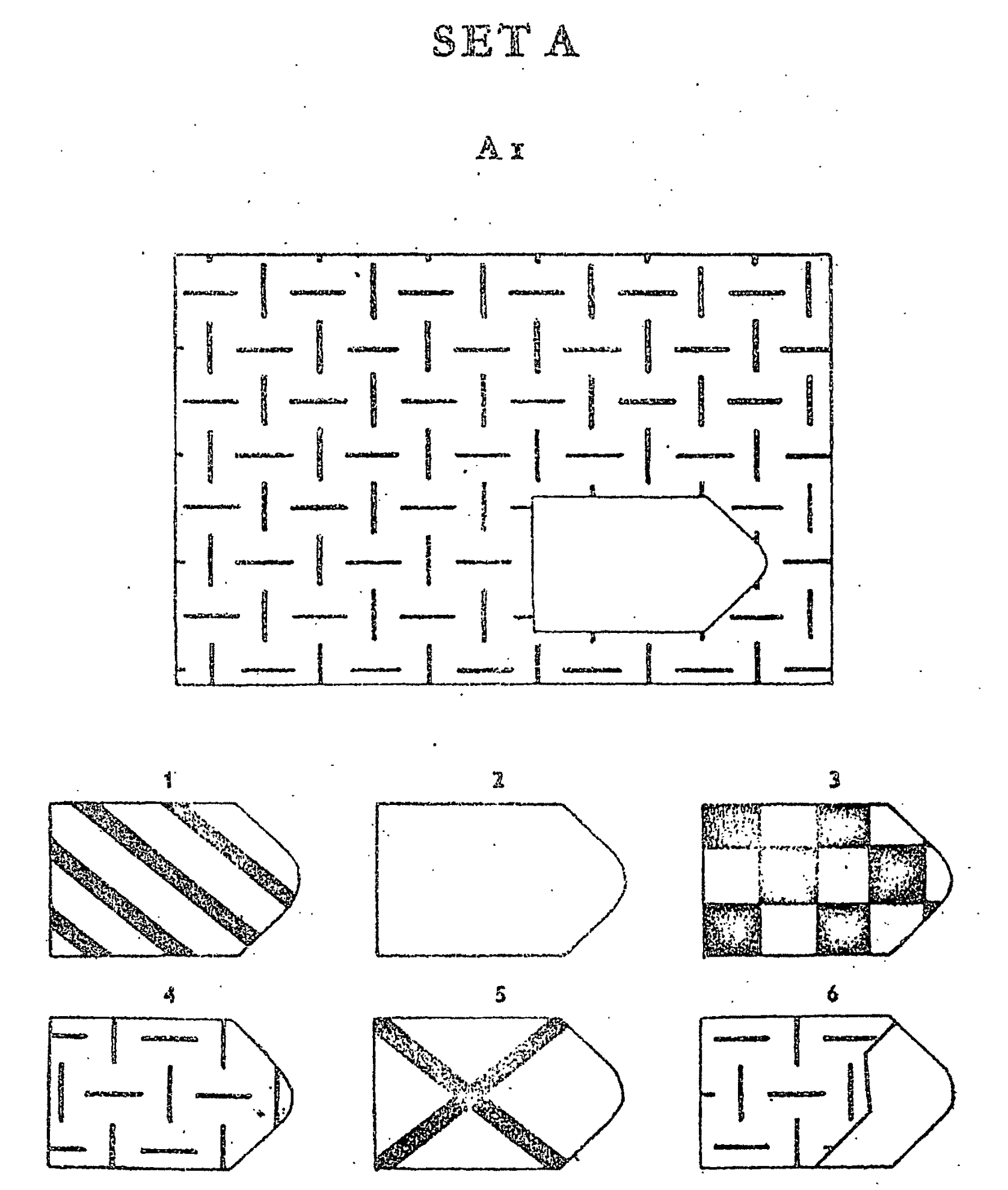
“At the top,” Ronnie Chiu said, “it says Set A. And you have a column A, on your scoring form.”
I surmised that by scoring form, he meant the sheet of paper that had been given to me alongside the stapled booklet.
I glanced at it, and found that he spoke the truth: a tall narrow grid was laid out on this auxiliary sheet, with five large and rather pretty letters marked out along its top (A B C D E), and numbers in the same style running down its left side (1 2 3 . . .).
“This is A.1,” Ronnie Chiu said, pointing to the figure in its second and magnified manifestation, on the booklet held out at the front of the room.
“You see what it is,” he said, his voice louder now.
There was now something resonant and majestic in the voice, I thought, despite its expertly maintained air of expert neutrality. The room felt too small, too pedestrian, to be a fitting auditorium for it. It was a voice meant for the open air, for rocky outcroppings close to the front, where an army stands massed and waiting, and a voice is needed to rouse it for the push past the next and final hill.
You see what it is. It was not a question. He did not have to ask; he knew. He believed in us. He did not doubt, even for a moment, that we would see what it is.
I stared at the figure, and tried to see what it was.
“The upper part,” said Ronnie Chiu, “is a pattern with a bit missing.
“Each of these bits below,” he said, indicating one by one the six small rectangles at the bottom of the figure, “is the right shape to fit the space, but they do not all complete the pattern.”
“Number 1,” he said, pointing to the first small rectangle, “is quite the wrong pattern.”
“Numbers 2 and 3,” he said—pointing to the one, then the other—“are wrong: they fit the space, but they are not the right pattern.”
“What about Number 6?”, he asked.
“It is the right pattern,” he said, with a substantiating gesture. “But it does not go all over.”
A nameless malaise was foaming up inside me. I watched Ronnie Chiu, and the blackboard behind him, and the dark spearlike and sheathlike forms plunging and grasping in reciprocal play across that chalk-smeared night.
“Put your finger,” Ronnie Chiu said, “on the one that is quite right.”
He looked at the other boy, at the front of the room, and then began to walk toward his desk. Evidently that boy was a quick study—or else a hasty fool—and had already deployed his finger, rightly or wrongly.
I looked down, again, at the figure.
I felt a chill fall across my arms, setting the hairs there on end. It was just as if a window had been opened, in the room—a window into a very cold, very windy, very cruel sort of night.
I know the sort of night I mean, for it is the sort of night that does befall Brooklyn, New York. At the very heart of winter. If the year is unusually cold, and unusually cruel.
The room had no windows, and so I knew that this had not really occurred. In this I was more well-informed than my own arms, which were now thoroughly dotted with goosebumps.
A sickness boiled, in my belly.
I looked at the figure.
I saw the figure there, and also, separately, the literality there.
The friendlike forms, ranged there in their multitude, as the courses of a feast might be laid out over a banquet table. Each a window into infinite space.
Each offering itself up, laying itself bare, so that I might know it. Each opening itself to me, as a flower opens, and laying out its innermost secrets for my inspection, as a plucked flower might be laid out on a botanist’s corkboard, with all its parts annotated for the benefit of the novice.
Each disclosing that which imaged it in the Original Creation, that which we shall all soon see, once we have gone up into that place.
I saw six small rectangles. I saw six witnesses to the truth that it was a glad and good thing, when He birthed His creation.
Six things which alone—even if they were the start and the end of creation, even if there were no earth or waters or firmament, but only these six, alone—six things which alone would justify His assessment, as He surveyed what He had made: that it was good.
Any one of them, alone, would do justice to that assessment. But the Original Creation is a creation of bounty, burgeoning, blossoming; it is the font that overruns, and the feast that fills; it is a creation of six, where one might do.
I saw six sisters, each dearer to me than my Sister, Miriam Schoen. I saw six mothers, who birthed me long before my Mother, Ruth Schoen, knew the touch of mortal man. Who will bear me again, with joy, and birth me again, in jubilation—in the days that are to come.
I heard Ronnie Chiu’s noble voice, playing back again in my mind. Trusting me, believing in me. Urging me onward. Through the cold chalky night, to the next and last hill.
Number 1 is quite the wrong pattern.
Put your finger on the one that is quite right.
I was Solomon, with six women prostrate before me, weeping.
I was a mother, watching a king heave a sword aloft.
And opening her mouth, to scream.
“Mr. Schoen?”
I will remark, in admiration, that the note of concern in Ronnie Chiu’s voice did not seem at all patronizing.
I do not think I really screamed. Perhaps I should have, but in any case I did not. I am fairly sure of this.
I have learned how to keep up appearances, when among men.
But I must have made some displeasing sort of noise. It was less severe than a scream, but there is where my knowledge of the event leaves off. Matters of lesser importance do have a tendency to recede from my awareness, as I am a busy sort, and one given to intense concentration when the moment demands it.
“I am all right, Dr. Chiu,” I said.
I did not say, “I feel all right,” which would have been a lie.
He was hovering, now, quite close to my desk. He must have noticed, I thought, how I had not placed a finger onto any part of the page.
But how could I?
How could anyone?
I caused snatches of Ronnie Chiu’s monologue to play back, again, in my mind, as fortification.
Put your finger on the one that is quite right.
You see what it is.
I stared, as if trying to bore a tunnel through the page, and the desk beneath.
I saw six seeds that were planted once in Eden, and knew this was not enough. I saw what on its own would have pleased Him, if it had been all He had ever created. And knew this was not enough.
I asked myself what else was there.
I asked myself what I might do, if I were not myself.
If I were Ronnie Chiu, or the other schoolboy, at the far desk. Or my Sister, Miriam Schoen.
If I were like them, and did not know. If I had forgotten.
Quaking, and swallowing my screams, I pleaded to myself: go.
Go, now, to the precipice, and leap. Plunge headlong into evil, armed with faith, knowing that you will soon return. Fear thou not, Mr. Schoen, for I am with thee.
Go, leap, FORGET.
I looked, again, at the page.
At the figures on the page.
I do not think I have ever felt pain as I felt it, then.
I saw what it was.
I understood, as I had not before, the inner meaning of Ronnie Chiu’s speech. I understood, perfectly and exactly, the underlying intent of each of the words comprising the brief monologue he had delivered, at the front of the class.
He had said, the upper part is a PATTERN, with a bit MISSING.
He had said, they FIT THE SPACE, but they are not the right PATTERN.
He had said, it is the right PATTERN, but it does not GO ALL OVER.
He did not speak of my loved ones, of my sisters and my mother and my children, of my garden, of the blooms that abound in it.
Of course he did not! He had forgotten!
And not only that: he was a priest of forgetting!
When he spoke at the front of the room, in his proclaiming voice, he was proclaiming the very logic of forgetting!
The Original Creation is a creation of much and many; it is the font that runs over, and every thing within it is a font, and runs over. And every pair among these things is, separately, a font, and runs over. So too for every triad. So too for all the unenumerated numbers of the joyous that did once couple there, and will again couple, in days to come.
Ronnie Chiu had said: put your finger on the one that is quite right.
I knew that any one of the six could be placed in union with the larger figure, and be fertile, and bear fruit with it, and be joyous. In each of these unions there was some special charm, something wholly unique, which no one with a matchmaking spark in him could possibly resist.
Number 1 is quite the wrong pattern. You are no matchmaker, Ronnie Chiu. You know nothing of the heart, or of what is proper in matters of coupling.
But you know how to forget.
You know, Ronnie Chiu, how to forget your body. To forget the food you eat, the air you breathe. To hollow yourself out, and forget everything, until even the mind that forgets has forgotten itself.
Until there is only the PATTERN, the ghost without organs, the man without breath, the husk that has been hollowed.
You must not think me too much the holy fool. You must not think that I could not see what was before my eyes.
What you have no doubt seen. Number 4, with its lace of vertical and horizontal beams. The same lace of beams, in the upper part. The way that the fragmentary beams, caught at the edges of Number 4, could be made whole by corresponding fragments on the inner fringe of that upper part.
I saw it, before, but I knew I was being tested. And so I went in search of Truth.
I saw it, but I did not see that it was the very answer which was desired of me, in this very TEST.
I did not see, at first, that it was held to be of significance.
Because it was, in fact, of no significance.
I only came to understand the test when I made myself forget this distinction. Because it was precisely the obliteration of this distinction which the test was intended to measure.
The hollowing-out of body and mind. The substitution of a scapegoat for the one whom He has demanded, in sacrifice.
In place of the belly, a figure, an anatomical diagram. In place of the feast, a figure, a billboard hawking treats. The one cannot nourish, the other cannot digest—but what is the difference?
In place of nourishment, we shall have a system of flows and negative feedbacks. In place of digestion, we shall have a system of flows and negative feedbacks. In place of creation, we shall have a blackboard sketch of a world.
It is as though I had been handed an empty box, wrapped sumptuously in red and green and festooned with festive bows, and told: here, here is your gift. Are you not pleased?
“I understand, now,” I said, to Ronnie Chiu.
I put my finger on Number 4.
I looked up, and saw his smile. And his wide eyes, not quite staring.
He nodded, slightly, and then turned. He receded from me, and took up his former place, at the front of the room.
“Yes,” Ronnie Chiu said. “Number 4 is the right one.”
“So,” he continued, “the answer to A.1 is 4.”
“Write 4 here,” he said, pointing, “against number 1 in Column A on your scoring form. Do not turn over yet.”
I picked up my pencil, and did as he bade me.
Ronnie Chiu inhaled, deeply, and then spoke at length.
“On every page in your book,” he said, “there is a pattern with a bit missing.
“You have to decide each time which of the bits below is the right one to complete the pattern above. When you have found the right bit you write the number of it down on your scoring form against the number of the pattern.
“They are simple at the beginning and get harder as you go on. There is no catch. If you pay attention to the way the easy ones go you will find the later ones less difficult.
“Try each in turn, from the beginning to the end of the book.
“Work at your own pace. Do not miss any out. Do not turn back. See how many you can get right. You have as much time as you like.
“Turn over and do the next one.”
I turned the page.
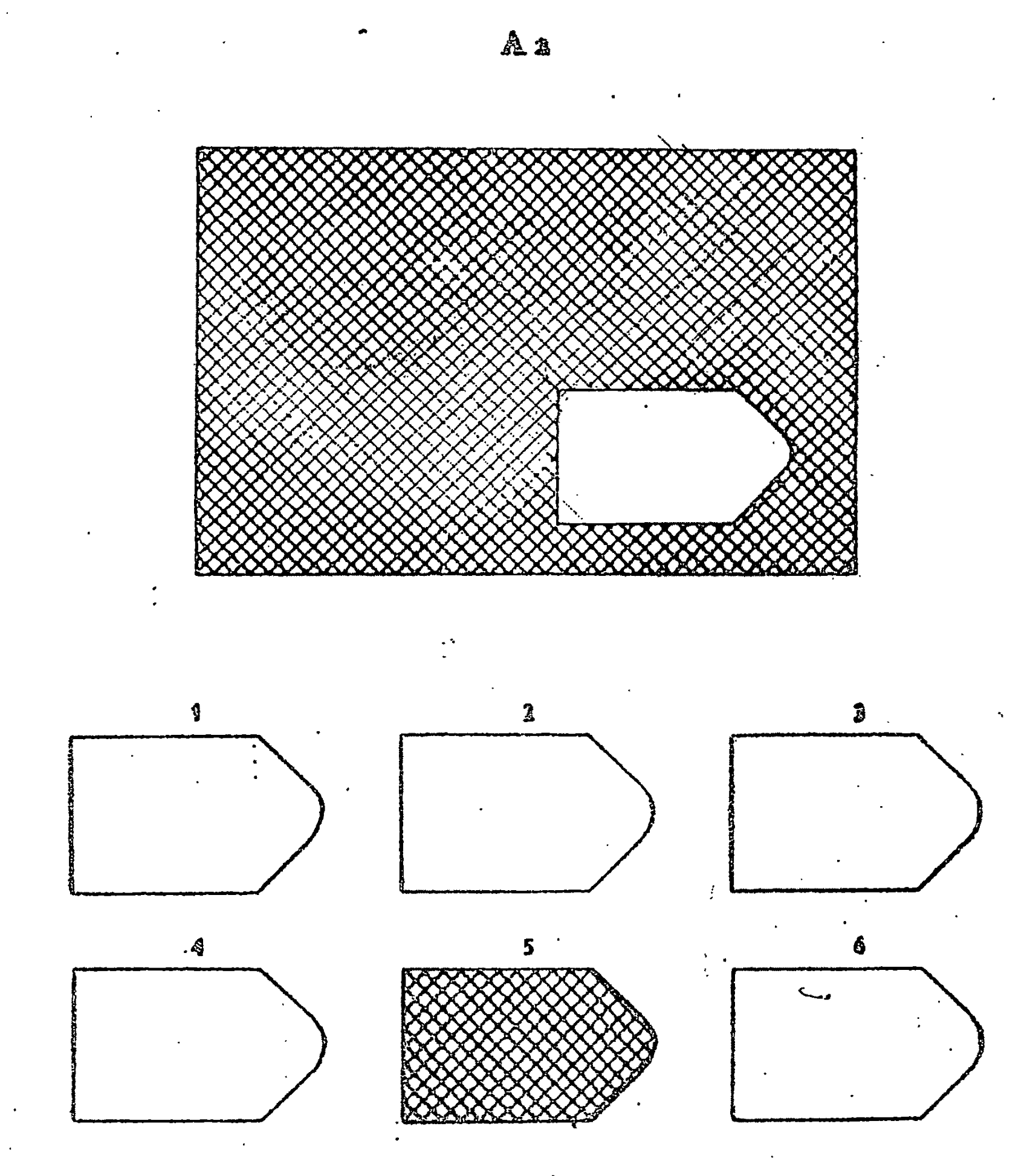
I saw the garden, and the many gathered there, in joy.
I swallowed my screams, and made myself also see the awful, hideously simple face which Ronnie Chiu meant me to see. The face nestling there in the heart of the garden, at the very center of the blossom that grows there.
I emptied out the box of myself, and placed my finger on Number 5.
At the front of the room, Ronnie Chiu glanced at me, and at the other boy, and nodded.
“The right one is of course Number 5,” he said, brightly, blandly.
(“Of course”!? I tremble before the man who can say such things! I would not want to meet him, and his army, on the field of battle.)
“See that you have written the figure 5 against number 2 in Column A on your form,” he said.
“Go on like that,” he said, “by yourselves, until you get to the end of the book.”
I did as he bade me.
He had said: they are simple at the beginning and get harder as you go on.
Remembering this, I doubted myself. For I perceived no such gradation, but only the one lesson, which was already contained in the figure which Ronnie Chiu called A.1.
Already contained, in its entirety.
This was a test of forgetting. If I had not grasped that, I could not have even completed A.1. Not, anyway, in a manner that could have satisfied Ronnie Chiu.
Once I had grasped that, I had grasped everything.
I moved rapidly through the pages, not wanting to dwell any longer than necessary on the unnatural and unseemly acts which each page demanded of me.
You must not think me too much the holy fool. You must not think that I did not perceive any gradation, at all.
But if anything it was a gradation of increasing ease. In large part, no doubt, to the gradual passing-away of the initial shock which I have narrated above.
In part, also, to the accumulation of spurious adornment in the later problems, which provided a welcome distraction from the bleak and poisoned seed that I knew was nestled in each problem’s innermost heart.
In this respect, A.2 was the cruelest of them all, having no finery in which to cover its nakedness, and no means by which to conceal the sickness in its body.
I did notice another change, which you no doubt would have noticed too, in my stead.
In the problems listed under A, the upper part was a unified whole, with “a bit”—to use noble Ronnie Chiu’s phraseology—chopped out of it. I discovered, however, that this was not the main course on which that noble man meant me to sup, but only an appetite-whetting prelude.
In the problems listed under B, and thereafter, there was instead a grid of three elements by three, with one of the nine elements omitted.
As in C.3, for instance.
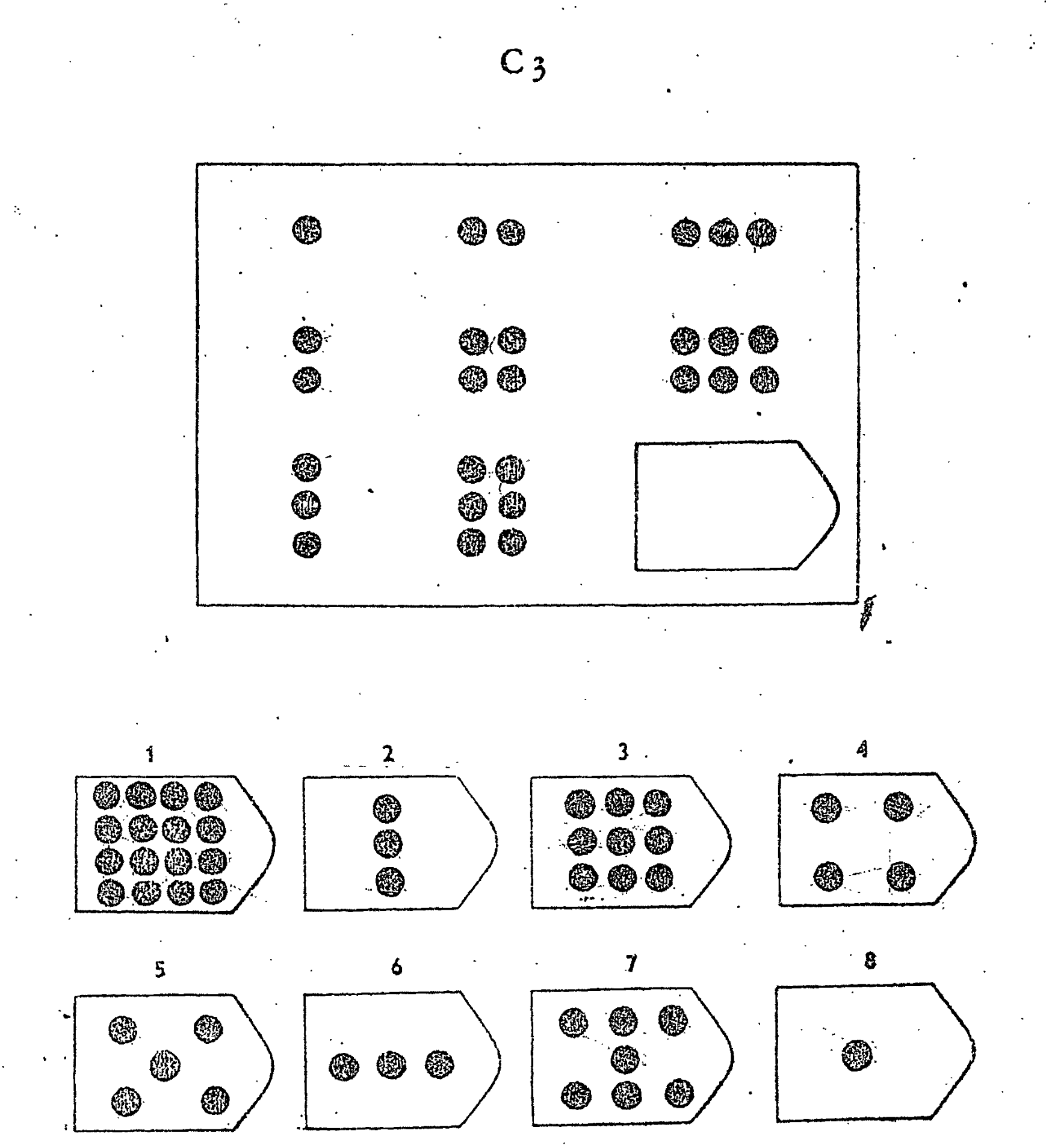
Here, I suppose I must mention—lest my star, lately risen so high in the firmament of Frederick’s estimation, fall precipitously out of that same firmament, and fall headlong to earth, and fall further, into the abysses that are under earth!—I must mention, I repeat, that the notion of PATTERN employed here was rather different than it had been in the series listed under A.
For in the one case, PATTERN meant something like the repetitive texture of a garment or tablecloth. While in the other, it meant something closer to a ghostly system of flows and feedbacks, as it were superposed onto the body of the grid, and in some sense standing in for that grid, or vice versa.
This distinction is of no significance.
But I mention it, in honor of a great friend and foe. To do what is proper, regarding that most learned scholar of cybernesis and that most illustrious conversationalist, whose bracing and challenging spirit has enlivened many a lunch period and after-school stroll over the course of this last and most difficult December. To you, Frederick!—to you, dear friend, and to you, most redoubtable knight of my loathed and respected Adversary!—to you, I dedicate this observation. Seeking your continued favor, I note it here, contravening my usual rule in matters which are of no significance.
Except for those already noted above, I perceived no gradations, of difficulty or of anything else.
I moved rapidly through the pages, and soon met the last hill.
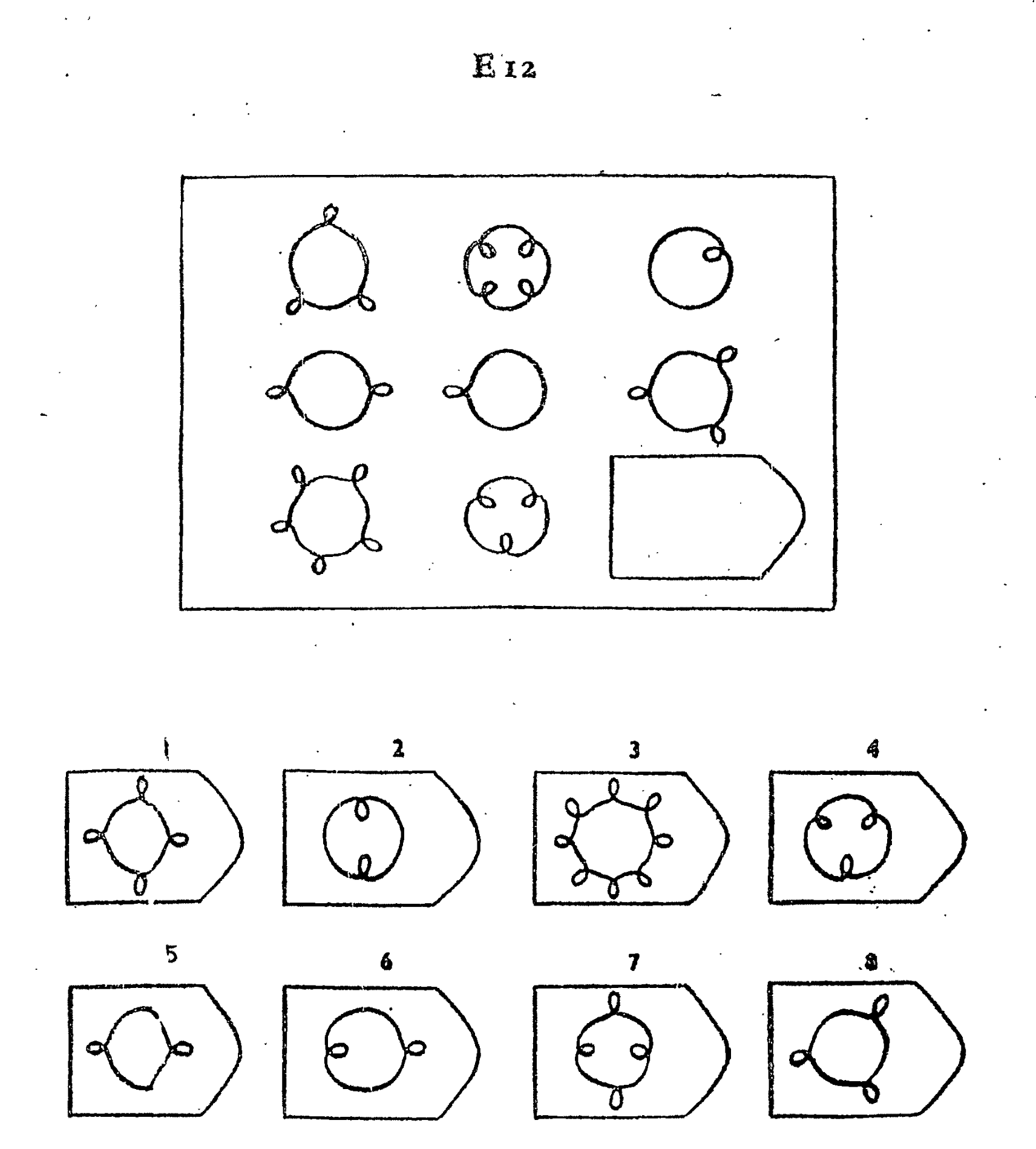
I had learned by now that before turning each page, I must clamp my heart shut, and hollow myself out, in preparation. I do not think I even saw what was there, when I confronted E.12. Not even for the briefest moment.
I only forgot, and thus knew; I only closed my eyes, and thus saw.
I marked number 5, in the place where the E of the scoring form met its number 12.
(Or rather, “against” its number 12—if we are sticking to Ronnie Chiu’s odd, adversarial phraseology.)
(But then, it was not really odd, at all. Every word he had said, in this room, had an inner meaning, and was directed toward a SINGLE purpose.)
I raised my hand, meaning to attract Ronnie Chiu’s attention.
The interaction that followed was brief, and had a false sheen of normalcy to it.
It was only as he was walking away from my desk, with my scoring sheet and booklet under his arm, and a serene smile on his infant’s face—it was only then that I saw, and felt, the full enormity of what I had done.
I despaired.
I would have wept, and screamed, if it were not prudent to keep up appearances, when among men.
I thought I had known the world. But the world had worsened, on that day.
Or it was worse, already, and yet I had not known.
Goosebumps rushed across me. The air over my arms was newly cold, and newly cruel.
I felt something shift within me. I had thought my doctrine complete, but it was not. Today, it would be emended.
I had thought that remembering was an act of will, which pushed actively against a mere passive, lifeless sea of forgetting. I had thought that I was a man, while my enemy was only the earth, the mindless earth.
Yet here, in this room, a man stood pronouncing the very logic of forgetting! Not as a passive victim of that logic, but as its conscious scholar and willing disseminator! A doctor! A doctor of forgetting!
That was the day I first perceived that there was an Adversary in the world, acting against me.
I had thought my task difficult enough, before. Now I saw that it contained difficulties of an entirely different, and higher, order than any I had hitherto imagined.
There was no window in the room, and the cruel air poured in through it. There was no wind, and I shivered against it.
I breathed in, deeply. I watched the formless leviathans swooping in the empty air. I heard the absence of bells, and the silence of angels, which marked for all time this most cruel, most empty moment.
I opened the door to my heart, which I had previously clamped shut, so as to face the pages without screaming. I gathered up all the forces that were within me.
I spoke, though the ignorant heard nothing.
I spoke, and denounced my Adversary.
I spoke then, and speak now, in my FULL VOICE.
Which has twin angels chorusing it, though you do not see them, you who see nothing.
Which wraps my every word in wingèd quotation marks, testifying utterly to the entire and manifest Truth of those words, as things written already at the time of my birth, and never to be refuted, no matter what might befall my body later on.
Which does not make waves in the air, or make waves in anything, or move the air in any way, but is ONLY A VOICE.
Which is a LITERALITY, entirely its own self and only its own self, and is wholly unsubstitutable, and wholly unsystematic, and wholly unregulated.
Which is without inputs, besides my own will, and without outputs, besides Truth.
Which sings, in its every syllable, against cybernesis and against my Adversary!
How did Moses speak, when he came down from the mountain, and beheld the calf? How did Isaiah speak, faced with the iniquity of the house of Judah?
In that way I spoke, then, and speak, now.
On this day, I said, with twin angels attending me and wingèd quotation marks wreathing my words, on this day I have met my Adversary!
On this day, my eyes have been opened!
My Adversary has lain in wait, not revealing himself to me. But on this day I myself reveal him!
I dedicate this day to my Adversary!
I consecrate the ground of this schoolroom to his iniquity, for its cunning demands proper respect and reverence.
And I consecrate the ground of this schoolroom to his utter defeat and ruin, the rout of all his armies, the crushing of his bones and his people’s bones, down to the last man, until there is nothing left save rubble, and until even that rubble is no more!
Until there is nothing left of him but the memory of him! Which memory I alone shall cause to persist through the ages, and only because I, alone, choose to do so!
I have said that I was given to the earth, so that all might remember, and so that all might rejoice. And it is so!
It is so, and it will be so, after my Adversary is crushed to bone and blood and marrow, and after that bone and that blood and that marrow are no more!
Do not think you can hide any longer, Adversary. I have seen you, today, in this room, through your knowing or unknowing agent Ronnie Chiu, and through the figures he has shown and the doctrines he has propounded.
I know you, now. I will find you, and your people, and I will crush them, and break them, and grind them into dust, and I will not cease to do these things until there is nothing left.
Nothing! Do you hear me?
Know that I have spoken, and know that I have spoken thusly. On this day, my Adversary, our game becomes a different sort of game.
I leave the next move to you, and would bid you luck, if there were any chance at all that such a blessing could spare you from your unenviable and inevitable fate.
I exhaled, and let my clenched muscles fall slack. The accumulated powers and radiances which had attended me now sloughed from my body, and flew from the room, and returned to their heavenly perches, and rested, as even angels must rest after a great labor.
I heard the drone of the fluorescent bulbs, and saw the meek cowering of feeble shapes in the corners of the blackboard, and saw the crisp, pencil-like body of Ronnie Chiu standing amid these shapes, squinting at a stack of paper.
He held several stacks of paper, and squinted at them. He shuffled them in his hands, and squinted, and shuffled them again.
“Wow,” he muttered.
“You really tried your hardest, today, didn’t you? Mr. Schoen, Mr. Eggert?”
I said nothing.
“Really tried your hardest, I can see that,” Ronnie Chiu said, warily, and with poorly concealed awe.